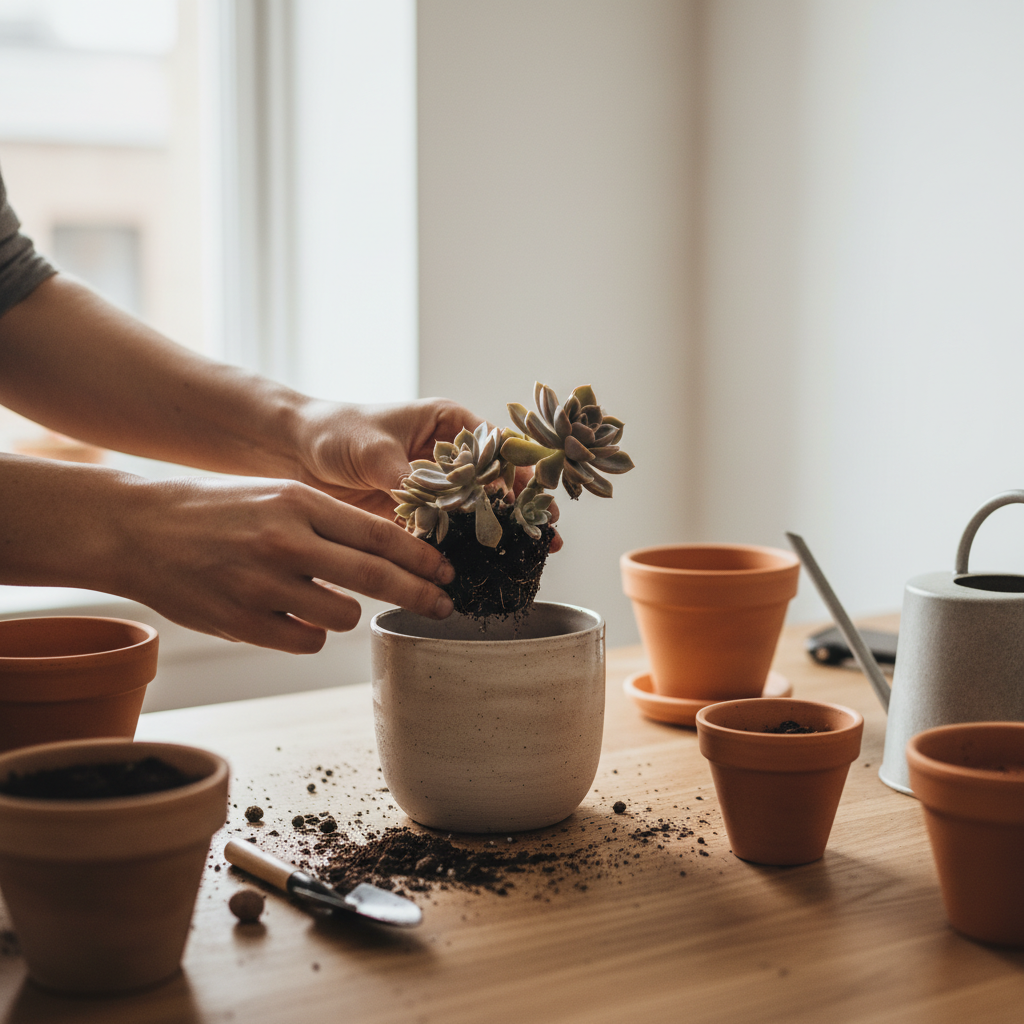
It’s 3 p.m. in February, and someone walks into the shop with a stretched-out Echeveria in a pot that’s basically peat soup. At least once a week, someone brings in a succulent that “just started collapsing” after a fresh repot, and the cause is usually the same: too much pot, too much moisture, and soil that holds water for 10 days when it should drain in 10 seconds.
Succulent repotting is not hard, but it is very easy to do badly. I’ve repotted thousands of plants, and the biggest mistake I see is people treating a jade plant, a Haworthia, and a Monstera like they all want the same setup. They don’t. Succulents want air around the roots, a pot that dries fast, and a pause after repotting so the roots can settle.
Use a small pot, gritty mix, and a dry-down period. If the roots were damaged or the plant was freshly watered, wait 3-7 days before watering again.
1. The pot size mistake I see every spring
Most people repot into something 2 to 3 inches wider than the old pot because it feels safer. For succulents, that usually means extra wet soil sitting around a tiny root system for 14 days or more. A 4-inch rosette in a 6-inch ceramic pot is how you end up with rot, not growth.
I’d rather see a snug terracotta pot with a drainage hole than a decorative cachepot any day. Terracotta pulls moisture out faster, which matters if your home sits around 55-60% humidity or your plant lives on a north-facing window ledge. Plastic can work, but only if you’re disciplined about watering. Side note: glazed pots look pretty, but they’re not doing your succulents any favors.
What I pick in the shop
For an Echeveria, Graptopetalum, or Sedum, I usually go for a pot just 1 inch wider than the root ball. For a chunky jade plant, Crassula ovata, I may go 2 inches wider if the plant is top-heavy. If the plant is a Monstera ‘Thai Constellation,’ that’s a different conversation entirely—don’t use succulent rules on a tropical aroid. People mix those up constantly.
At 68-78°F (20-26°C), roots recover faster than they do in a chilly 60°F (16°C) room. But even then, bigger is not better. Smaller is safer. Your mileage may vary if you keep plants in a very dry room, but in most homes, compact wins.
2. Soil that drains fast without turning to gravel
You’ll see this advice everywhere — “use cactus soil and call it done.” That’s wrong because many packaged cactus mixes still hold too much peat. I’ve squeezed out store-bought mix that stayed damp for 8 days. That’s too long for most succulents, especially in winter when rooms hover around 65-70°F (18-21°C).
I prefer a gritty blend: about 50% cactus mix, 25% pumice or perlite, and 25% coarse orchid bark or lava rock. For really rot-prone plants like string of pearls, I push the grit higher. The goal isn’t bone-dry dust. It’s airflow. Roots need oxygen as much as water.
If you like numbers, aim for a mix that dries noticeably within 3-5 days in a small 4-inch pot. In a humid apartment at 65% humidity, you may need even more pumice. I tried pure perlite once for a batch of offsets, and it didn’t work well; the roots never anchored properly. That taught me to keep some organic material in the blend.
A quick note on watering after the repot
If the roots were firm and you barely disturbed them, I still wait 2-3 days before watering. If I had to trim mushy roots, I wait 5-7 days. That pause is boring, but it saves plants. Succulents hate wet roots sitting in fresh cuts.
3. How to handle the roots without turning the plant into a pile of leaves
Unpot the succulent gently and shake off the old mix. You don’t need to scrub every particle from the roots unless the soil is sour or infested. At least once a week someone arrives with roots rinsed clean like they’re prepping salad greens, and then wonders why the plant sulked for a month. That’s overkill.
Trim only the roots that are black, mushy, or hollow. Healthy roots are usually firm and pale tan. If you break a few fine roots, that’s fine. If half the plant comes away in your hand, stop and let the damage dry before you pot it up. I keep a pair of clean snips and a small tray nearby, because chaos is how offsets get lost.
For rosette types like Echeveria elegans, hold the base, not the leaves. The leaves snap off if you twist. For thicker plants like jade, you can be more assertive. I haven’t figured out why some customers can repot a jade with bare hands and others drop one leaf and panic, but confidence helps. So does a stable work surface at about table height.
After repotting, set the plant somewhere with filtered light for 5-7 days. An east-facing window with 2-3 hours of morning sun works well. If your only option is a very hot south window in July, pull it back 18-24 inches for a week.
4. The aftercare schedule that keeps them compact
Freshly repotted succulents don’t want a spa treatment. They want calm, dryness, and a little restraint. Watering too soon is the fastest way to undo all your careful work. If the plant looks wrinkled after 4 days, that still doesn’t always mean it needs a drink. Roots need time to reconnect.
For most common succulents, I wait 3-7 days before the first watering. Then I water thoroughly and let the pot drain completely. That usually means about 150-250 ml for a 4-inch pot and more for larger containers, but the real test is whether water runs out the bottom. If it doesn’t, you’re probably under-watering or your mix is too dense.
Keep temperatures between 65 and 80°F (18-27°C) if you can. Cooler than 60°F (16°C) slows recovery. Hotter than 90°F (32°C) with dry air can stress tender roots, especially near a sunny window. In USDA zone 9, outdoor growers often repot in spring and keep plants shaded for a week. Indoors, I’d still choose mild weather over a heat wave.
| Situation | Best pot | Soil mix | First watering |
|---|---|---|---|
| Echeveria in a 4-inch pot | 4-5 inches, terracotta | 50% cactus mix / 50% grit | 3-5 days |
| Jade plant, Crassula ovata | One size up | About 60% cactus mix / 40% grit | 4-7 days |
| String of pearls | Shallow pot with drainage | Extra pumice-heavy mix | 5-7 days |
| Rot-prone plant in humid room | Smallest practical pot | Very gritty, fast drying | 7 days |
5. Signs the repot worked, and the ones that mean trouble
A successful succulent repotting usually looks boring for the first 7-14 days. The plant may sit still. That’s fine. What you want is firmness in the leaves, no blackening at the base, and no mushy collapse around the crown. New root growth won’t always show above the soil right away.
Watch for a plant that stays limp after watering, smells sour, or has leaves dropping from the center. That’s not “adjusting.” That’s a problem. If the pot stays wet for more than 5 days in a 4-inch container, I’d check the mix and drainage immediately. Most guides say to water on a schedule. I disagree because the pot, room temperature, and soil texture matter more than the calendar.
One practical example: a customer brought in a Haworthia in March after using a deep plastic pot and dense potting soil. We moved it into a 4-inch terracotta pot with a gritty mix, waited 6 days, and watered with 180 ml. Two weeks later it was firm again. Not glamorous. Just effective.
FAQ
Q: Can I repot succulents in winter?
A: Yes, if the plant is actively rotting or the soil is bad. Just keep it in 68-75°F (20-24°C) conditions and water lightly after 5-7 days. Growth may be slower than in spring.
Q: Do succulents need a bigger pot every year?
A: No. Many are fine in the same pot for 18-24 months. Repot when roots circle heavily, the soil breaks down, or the plant dries out too fast after 2-3 days.
Q: Should I top dress with rocks?
A: I wouldn’t. Decorative gravel traps moisture at the surface and makes it harder to read the soil. If you want a clean look, use a gritty mix and a neat terracotta pot instead.
Bottom line: keep succulent repotting small, dry, and airy, and your plants will reward you with compact growth instead of mush. What pot and soil mix are you using right now?
Related reading
Sources: canadiansucculents.net, hojnysucculents.com, planetdesert.com