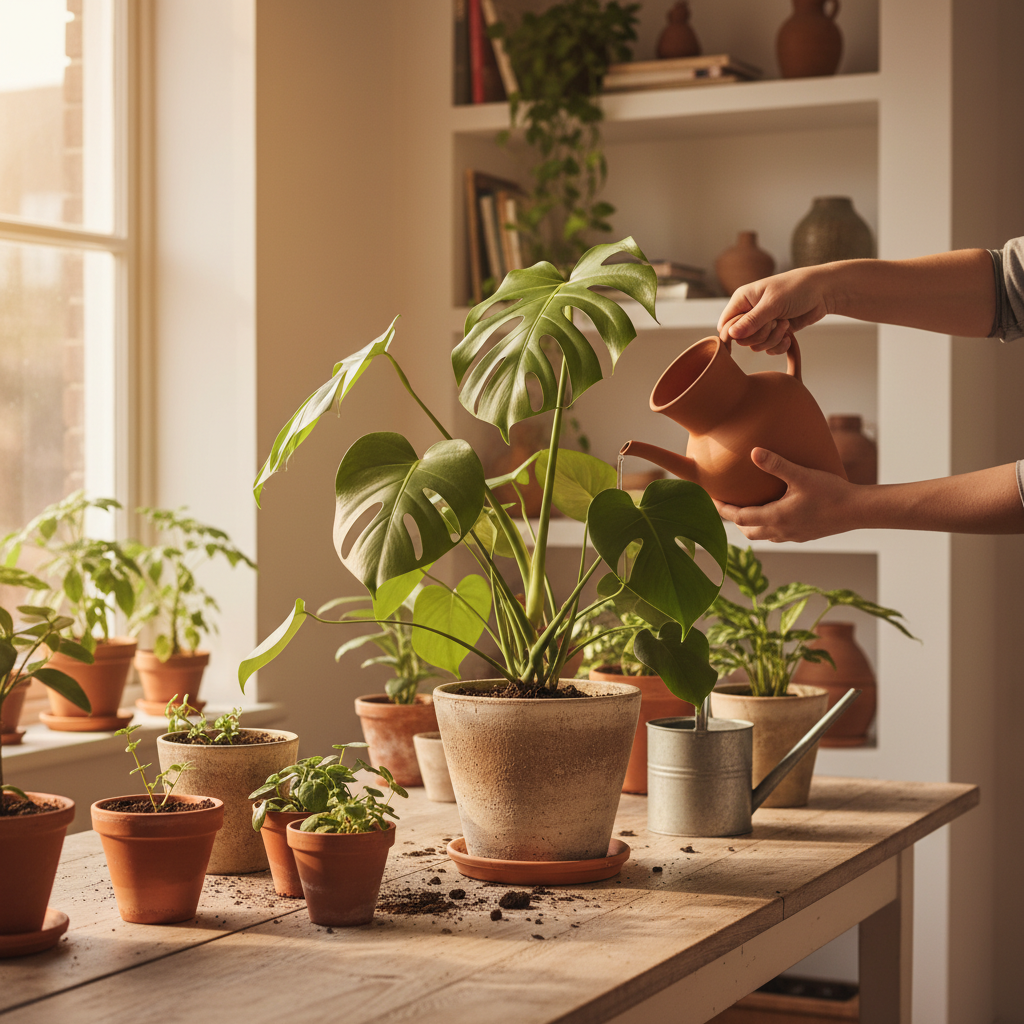
Last March I noticed three Monstera deliciosa on the same bench, all with the same complaint: yellowing lower leaves and soggy stems, even though none of them looked “overwatered” at first glance. Two had been sitting in plastic nursery pots inside decorative cachepots, and one customer had been giving hers 250 ml every three days because a video told her that was “gentle.”
At least once a week someone brings in a Monstera with a mushy petiole and says they only watered when the surface looked dry. That’s the trap. The surface lies.
Why does monstera watering go wrong so often?
Most watering mistakes start with the pot, not the plant. Monstera deliciosa and Monstera adansonii want moisture, but they hate sitting in dense, airless mix. If the roots can’t breathe, they stop pulling water, and then the leaves act thirsty even while the root ball is staying wet.
Most guides say to “water less.” I disagree because that advice is too vague. Less often can still be too much if the pot is oversized, the mix is peat-heavy, or the plant is in a cool room around 65°F to 68°F (18°C to 20°C). In my experience, watering frequency matters less than how fast the pot dries.
Side note: a 10-inch plastic pot holds moisture very differently than a 10-inch terracotta pot. Same plant, same window, totally different schedule.
What I see most often: a Monstera in a decorative pot with no drainage, sitting in a north-facing window, getting watered on a calendar instead of by feel. That combo is basically root rot with a head start.
How do you tell if the soil is actually ready?
Forget the “top inch” advice. It’s overrated. The surface can feel dry while the lower half of the pot is still wet for another 4 to 7 days, especially in a 12-inch nursery pot packed with fine peat. I usually tell customers to check deeper: slide a finger 2 to 3 inches down, or use a wooden skewer and pull it out to see if it comes up cool and damp.
If the pot feels noticeably lighter and the skewer comes out mostly clean, that’s your cue. If it still feels heavy, wait. A healthy Monstera in active growth usually wants a full drink when the mix has dried about halfway down, not bone-dry all the way through.
What I look for in the shop
Leaves that droop but stay firm often mean “thirsty.” Yellow leaves near the soil line, a sour smell, or blackened stems point to staying wet too long. I’ve tried telling people to water by leaf curl alone, and it didn’t work well. Curl can mean underwatering, root stress, or just a hot afternoon near a vent.
Water your Monstera based on pot dryness and root health, not the calendar. Drainage and mix matter as much as timing.
How much water should you give each time?
For a typical 8-inch Monstera in a fast-draining mix, I’d rather see one thorough soak than three tiny splashes. Pour until water runs out of the drainage holes, then stop. For many pots that’s roughly 400 to 700 ml, but the real number depends on pot size, root mass, and soil blend. A root-bound plant in a chunky aroid mix may need less total water than a freshly repotted one in a larger container.
I’m mildly opinionated here: self-watering pots are usually not my first choice for Monstera. They can work, but they also hide bad habits. If you’re still learning the plant, a plain nursery pot with drainage inside a cachepot is easier to read.
Use room-temperature water, around 68°F to 75°F (20°C to 24°C). Ice-cold water isn’t fatal, but it’s unnecessary, and very cold tap water can shock roots on a stressed plant. If your home runs dry in winter, a pebble tray helps humidity a bit, but it won’t replace proper watering.
What changes by season, light, and pot material?
The same Monstera can need watering every 6 to 8 days in summer and every 10 to 14 days in winter. That’s not because the plant is being dramatic. It’s because light, temperature, and evaporation all shift. Near an east-facing window with two hours of direct morning sun, soil dries faster than it does 6 feet back from the glass.
Humidity matters too. Around 40% to 55% indoor humidity is fine for most homes, but a plant near a heat register or in a room below 35% will dry faster. USDA zone 9 patio conditions are a different story entirely; outdoors in filtered shade, watering can change after a single hot, windy day.
| Condition | Typical watering pace | What I’d choose |
|---|---|---|
| Terracotta, chunky aroid mix | 6–10 days in summer | More frequent checks |
| Plastic nursery pot, peat-heavy mix | 10–14 days or longer | Drainage holes, less water per session |
| Bright east window | Faster drying | Thorough soak, then wait |
| Cool north-facing room | Slower drying | Smaller volume, longer intervals |
My practical pick is a chunky mix with orchid bark, perlite or pumice, and a smaller portion of potting soil. If the mix feels like mud, it’s the wrong mix for Monstera. You’ll see advice everywhere telling you to “keep it evenly moist.” That’s wrong because evenly moist in a closed pot often becomes evenly soggy.
What should you do after repotting or when a plant looks unhappy?
After repotting, wait 2 to 4 days before watering if the roots were disturbed and the mix is already slightly damp. If the root ball was bone-dry, water once to settle the mix, then let it breathe. I water repotted Monsteras more cautiously for the first 2 weeks because the roots haven’t re-established yet.
If a plant is declining, don’t just add water. Check the roots. Firm, pale roots are good; brown and mushy roots need trimming. I tried rescuing a customer’s Monstera with extra water and misting first, and it only sped up the rot. We cut away damaged roots, switched to a 70% bark-based mix, and the plant finally stabilized.
For Monstera ‘Thai Constellation,’ I’m even more careful. It grows slower, so it uses water more slowly. That doesn’t mean “ignore it.” It means smaller drinks, better drainage, and less enthusiasm with the watering can.
Fast checks before you water
- Lift the pot and feel the weight.
- Check 2 to 3 inches down, not just the surface.
- Make sure the decorative pot isn’t holding runoff.
- Use a pot with drainage holes every time.
What’s the simplest monstera watering routine that actually works?
Here’s the routine I give customers who want fewer plant emergencies: check the soil every 3 to 4 days, water only when the pot has dried about halfway, and soak until runoff appears. Empty the saucer after 10 minutes. If the room is cool, stretch the interval. If the plant is near a sunny window or a vent, shorten it.
That’s it. Not mystical. Not weekly on autopilot. Just consistent observation.
For the record, a Monstera in a 6-inch pot may need water twice as often as one in a 10-inch pot. Pot size changes everything. So does the pot material. Terracotta breathes; plastic holds moisture longer. Pick the container on purpose, not because it matched the sofa.
FAQ
Q: Should I mist my Monstera instead of watering it?
A: No. Misting raises humidity for minutes, not days. It won’t fix dry soil, and it can even encourage leaf spotting if the room is cool and stagnant.
Q: Is filtered water better for monstera watering?
A: If your tap water is very hard or heavily chlorinated, filtered water can help over time. But the bigger issue is still drainage and timing. Good water won’t save bad soil.
Q: Can I water on a fixed schedule?
A: You can use a schedule as a reminder, but not as the rule. In summer my shop’s Monsteras might dry in 6 days; in winter the same plants can take 12 or more.
Water the roots, not the calendar, and your Monstera will usually tell you the rest.
Related reading
Sources: plantelio.com, abeautifulmess.com, spiderfarmer.eu, livelyroot.com, epicgardening.com