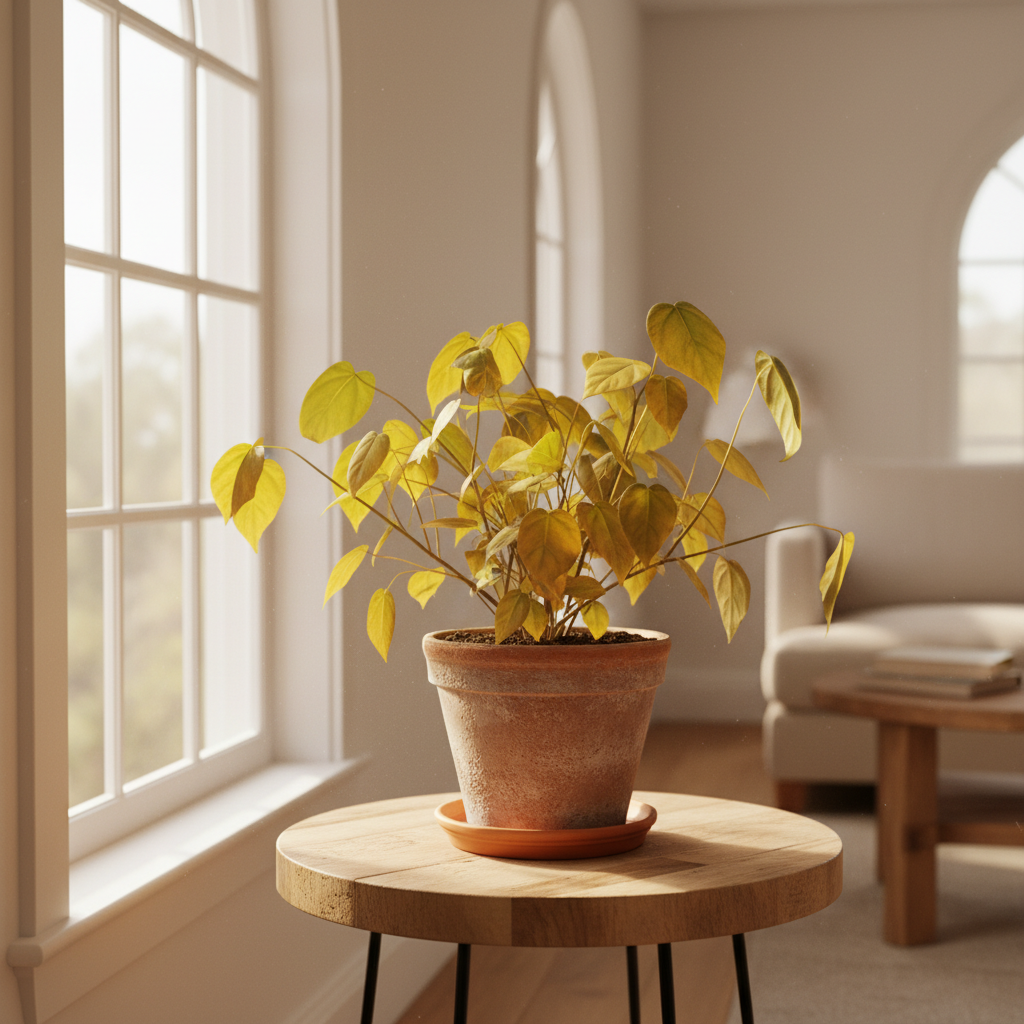
It’s 3pm in February, the kind of gray afternoon that makes every room look colder than it is. A Monstera on the counter has three yellow leaves hanging like bad news, and the customer is already blaming the fertilizer, the pot, and the internet. At the shop, that’s usually not the real story. Yellow leaves are the plant’s way of waving a flag, and the trick is figuring out whether it’s thirsty, drowning, starving, stressed, or just shedding an old leaf it never planned to keep forever.
Why do yellow leaves show up on a houseplant at all?
Most of the time, a yellow leaves houseplant problem is one of four things: watering trouble, light mismatch, root stress, or normal aging. A single lower leaf on a pothos, Philodendron hederaceum, or Monstera deliciosa turning yellow isn’t a crisis. A whole plant going pale, especially after the soil stayed wet for 10 days, is a different animal.
At least once a week someone brings in a fiddle-leaf fig or a peace lily and says, “I watered it more because it looked sad.” That move usually makes things worse. Roots need oxygen. If the potting mix stays soggy for too long, the roots can’t breathe, and the leaves start yellowing before they brown. On the other hand, if the plant has been bone-dry for 2 or 3 weeks, the oldest leaves may yellow and drop as the plant triages itself.
Side note: the pot matters more than people think. A heavy ceramic pot with no drainage hole is basically a slow-motion trap. I’d rather see a plant in a plain nursery pot inside a decorative cover pot than sitting in wet soil with nowhere to go.
What I look at before I touch the watering can
Check the soil 2 inches down, not just the surface. If it feels cool and sticky, wait. If it’s pulling away from the sides and the pot feels light, water thoroughly until you get runoff, then empty the saucer. For most tropical houseplants, indoor temperatures around 65-75°F (18-24°C) are comfortable. When a room drops below 60°F (15.5°C), growth slows and wet soil lingers longer. That’s when yellowing tends to stack up.
How do you tell overwatering from underwatering without guessing?
This is where a lot of internet advice goes sideways. People love to say, “Yellow leaves mean more water.” I disagree. Yellow leaves can mean the exact opposite, and the only honest answer is to check the roots, the pot, and the soil texture together. If the lower leaves are soft, the stems feel mushy, and the soil smells sour after 48 hours, you’re probably dealing with too much moisture. If the leaves are yellowing, curling, and crisping at the edges, the plant may have been dry for too long.
For a plant in a 6-inch pot, I usually tell customers to water when the top 1-2 inches are dry, which is often every 7-10 days in summer and closer to every 10-14 days in winter near a north-facing window. Your mileage may vary. A ZZ plant can go longer. A Calathea may want a different rhythm. This worked for Monstera, less so for Adansonii.
Humidity matters too. Around 40-60% is workable for many common houseplants. Below 30%, leaves can yellow faster after a missed watering because the plant loses moisture through the leaf faster than the roots can replace it. If you want a quick diagnostic, lift the pot, feel the soil, and look at where the yellowing starts. Bottom leaves usually point to watering or age; random upper leaves can point to light or pest stress.
Key Takeaway
Yellow leaves are a symptom, not a diagnosis. Check moisture, drainage, light, and root health before you change the care routine.
What if the plant is getting enough water but still turns yellow?
Then I look at light and roots. A plant parked 8 feet from an east-facing window may survive, but it won’t always thrive. Many tropicals want filtered light, not a dark corner lit by a lamp for 4 hours. If the room is too dim, the plant can’t use water efficiently, and the lower leaves fade first. If it’s getting two hours of direct morning sun through glass, that can be perfect for some plants and too much for others, especially if the leaf was already stressed.
Rootbound plants are another classic. I’ve repotted thousands of them, and I can tell you the root ball tells the truth. If roots are circling the pot, coming out of the drainage hole, or packed so tightly that water runs straight through without soaking in, the plant may be starving for space and moisture balance at the same time. That’s common in a 4-inch nursery pot left untouched for 12 months or more.
For repotting, I usually choose a pot only 1-2 inches wider than the old one. Bigger is not better. Too much extra soil stays wet too long, especially in a chunky mix that includes bark, perlite, and a bit of coco coir. For aroids, that mix beats dense peat-heavy soil almost every time. People see “moisture-retentive” on a bag and think it’s a virtue. Sometimes it’s just a long detour to root rot.
If you suspect pests, inspect the undersides of the leaves for stippling, webbing, or tiny moving dots. Spider mites and thrips can trigger yellowing before the damage is obvious from across the room. I haven’t figured out why some plants yellow first and others bronze first, but the pattern is consistent enough that I don’t ignore it.
| What you see | Likely cause | What to do |
|---|---|---|
| Soft yellow leaves, wet soil, sour smell | Overwatering | Let it dry, improve drainage, check roots |
| Crispy yellow edges, light pot, dry mix | Underwatering | Water deeply and adjust the timing |
| Lower leaves fading in dim light | Low light | Move closer to a window or brighter indirect light |
| Yellowing plus speckling or webbing | Pests | Inspect closely and treat early |
What should you do today so the yellowing doesn’t keep spreading?
Start simple. Remove a leaf only after it’s mostly yellow; don’t strip every slightly faded leaf just because it’s not perfect. A plant can still pull nutrients from a leaf that’s halfway green. Then check drainage. If the pot has no hole, repot. If the mix is dense and compacted, refresh it. If the plant is in a north-facing window in winter, move it a foot or two closer to the glass and watch for 7-14 days.
For a yellow leaves houseplant in a 70°F (21°C) room, I’d rather see one deep watering than five tiny sips. Water until you get a steady trickle from the bottom, then let the mix dry to the plant’s needs before repeating. Don’t keep “helping” it. That’s how customers end up with a mushy stem and a sad face.
If the plant is a Monstera ‘Thai Constellation’ or another variegated cultivar, be extra careful with light. It needs more light than a plain green Monstera because the white sections don’t photosynthesize. Too little light and the plant sheds leaves to compensate. Too much direct sun and the pale tissue can scorch. That balance is fussy, but not impossible.
One practical habit: write down the last watering date on a sticky note or phone reminder. Not forever. Just for 3 weeks. You’ll spot patterns fast, especially in winter when evaporation slows and the same pot that dried in 6 days in July may stay wet for 12 days in January.
| Situation | Best next move |
|---|---|
| Only one old lower leaf is yellow | Leave it alone until it’s fully yellow, then remove it |
| Several leaves yellow after a heavy watering cycle | Pause watering, inspect roots, and improve drainage |
| Plant sits far from windows | Move it to stronger indirect light for 1-2 weeks and observe |
| Leaves yellow with pests present | Isolate the plant and treat the infestation early |
Q: Should I cut off yellow leaves right away?
A: Not always. If a leaf is partly green, it can still feed the plant. I wait until it’s mostly yellow or fully spent, then remove it with clean scissors.
Q: Can yellow leaves turn green again?
A: No. Once a leaf has yellowed, that tissue won’t recover. The goal is to stop the next leaf from following it.
Q: What soil mix do you actually use for tropical houseplants?
A: A chunky mix with bark, perlite, and a smaller amount of coco coir or peat. It drains well but still holds enough moisture for roots to do their job.
Bottom line: a yellow leaves houseplant usually needs better diagnosis, not more panic—check the soil, the pot, and the light before you blame the plant. What’s the first thing you’re going to inspect on yours?
Related reading
Sources: soltech.com, thesill.com, prairiegardens.com, eplanters.com, costafarms.com