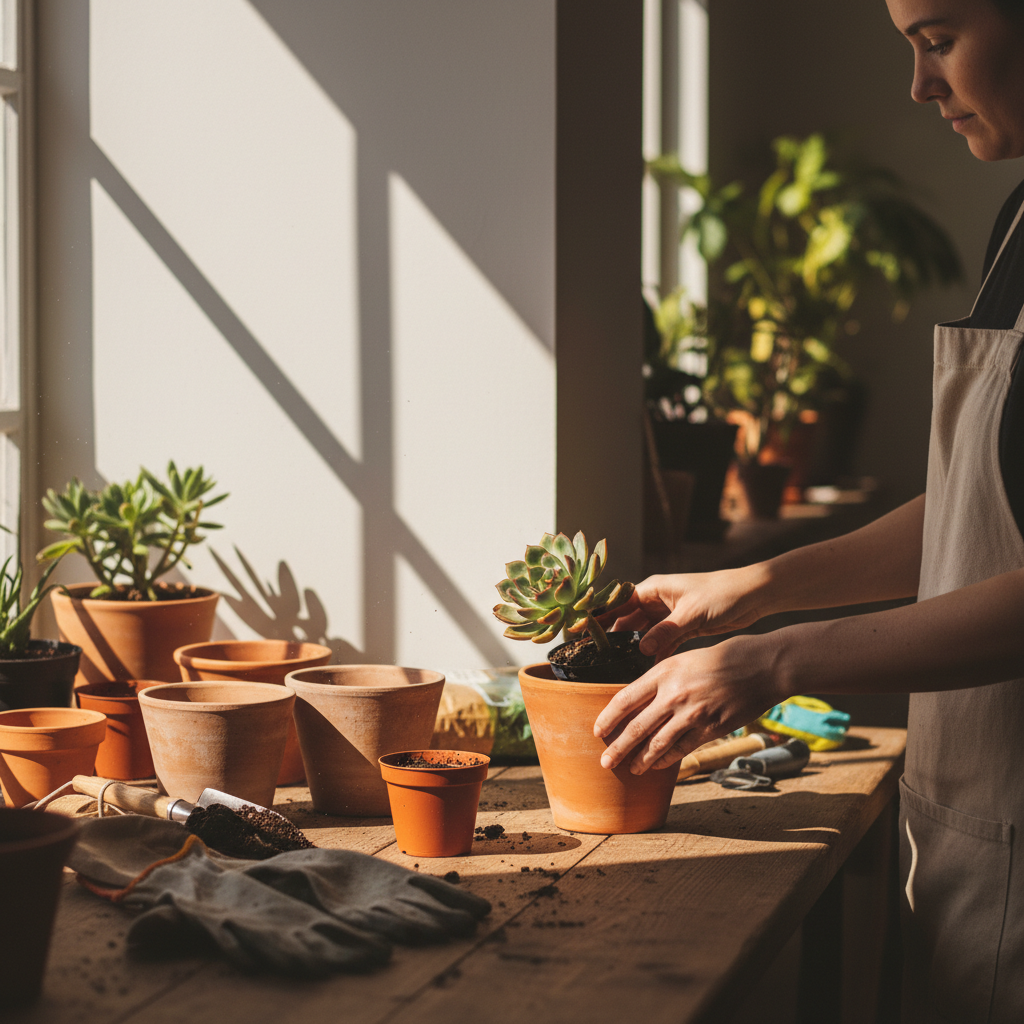
Stop using a moisture meter to decide when to repot a succulent. That gadget can be useful for thirsty foliage plants, but with cacti and fleshy succulents it often makes people wait too long, then water too soon after disturbing the roots. I learned that the hard way after a jade plant, Crassula ovata, sulked for weeks in a pot that was only one size too large. The fix wasn’t more attention. It was less.
When is succulent repotting actually worth the trouble?
Repotting is worth doing when the plant is clearly outgrowing the container, the mix has collapsed, or water sits around the roots longer than it used to. A healthy succulent in a 4-inch pot doesn’t need an annual makeover just because the calendar says spring. Most guides push frequent repotting; I disagree. Succulents often do better when left alone until they show a real reason.
Look for roots circling the pot, a top-heavy rosette, or soil that has turned dusty and hydrophobic. Penn State Extension-style guidance on container media is blunt about drainage: if the mix stays wet, roots lose oxygen fast. That matters more than pot fashion. In my experience, this is especially true for Echeveria and Haworthia, which resent soggy roots more than a slightly snug pot.
Side note: if your plant is in a north-facing window and stretching toward the glass, repotting alone won’t fix etiolation. It needs more light, not a bigger home.
What soil and pot size make the biggest difference?
Use a gritty, fast-draining mix, not standard houseplant soil straight from the bag. A blend with roughly 50% cactus mix and 50% mineral material like pumice, perlite, or coarse sand usually drains far better than peat-heavy potting soil. For a plant in a 4-inch pot, move to a container only 1 inch wider unless the roots are severely crowded. Bigger pots hold extra moisture, and extra moisture is where succulent repotting goes sideways.
The pot material question
Terracotta dries faster than glazed ceramic or plastic, which helps in humid rooms or USDA zone 9 summers where indoor temperatures can sit in the low 80s Fahrenheit (about 27–28°C). Plastic can work, but it asks for more restraint. If your home runs around 65–75°F (18–24°C) and 40–50% humidity, either material can be fine as long as the soil is airy.
For a cultivar like Sempervivum tectorum ‘Ruby Heart’, I’d rather see a shallow clay pot than a deep decorative planter. The roots are not trying to colonize a canyon.
| Choice | Better for | Main risk |
|---|---|---|
| Terracotta | Fast drying, humid rooms | More frequent watering |
| Plastic | Dry homes, forgetful watering | Stays wet longer |
| Glazed ceramic | Decorative displays | Slow evaporation |
How should you handle the roots without causing rot later?
Gently shake off loose old soil, then inspect the roots for black, mushy sections. Healthy roots should be firm and pale, not translucent. If you find rot, trim it with clean scissors and let the plant sit dry for 24–48 hours before repotting. That pause is one of those boring steps that saves plants.
Don’t bury the stem deeper just to make the plant look stable. Succulents hate sitting against wet soil at the crown. I tried that once with an Adromischus cristatus and ended up with a soft base after a cool spell around 55°F (13°C). I haven’t figured out why people still recommend “tucking it in” like a blanket. It’s a plant, not a toddler.
After repotting, keep the plant dry for about 5–7 days in a room near 70°F (21°C). If the roots were damaged, wait closer to 10 days. That small delay gives tiny root wounds time to callus before the next watering.
When do you water after succulent repotting, and how much is too much?
Watering too soon is the mistake that turns a routine repot into a rescue mission. Most succulents should not be watered on the day you repot unless the roots were bone-dry and undisturbed, and even then I’d still wait. After the pause, water thoroughly once, then let the mix dry all the way through before watering again. That might be 8–12 days in summer or closer to 2–3 weeks indoors during cooler months.
A practical amount is enough to moisten the root zone and see a little runoff from the drainage hole. For a 4-inch pot, that may be around 100–150 ml, but the exact volume depends on soil texture and pot size. The point is saturation followed by a full dry-out, not daily sips. This is where most moisture meters mislead people: the top reads dry while the lower half stays damp.
Keep the plant in 2–4 hours of morning sun or filtered light through a sheer curtain for the first week. If it sits in a hot west-facing window, the fresh roots can get stressed fast, especially above 85°F (29°C).
Key Takeaway
For most succulent repotting jobs, choose a slightly larger pot, a gritty mix, dry roots for several days, and a slow return to watering. That’s the whole game.
What are the fastest ways to tell if the repot worked?
Success looks boring. The leaves stay firm, the center doesn’t soften, and new growth appears after a few weeks instead of a dramatic overnight change. A repotted Graptopetalum paraguayense may pause before it perks up. That’s normal. A collapsed crown, however, is not.
Here’s the short version I keep on hand:
- Use a pot with drainage holes.
- Keep the new mix airy and mineral-heavy.
- Wait 5–10 days before the first watering.
- Give filtered light, not harsh afternoon sun.
- Check for firmness, not just color.
If you want one rule to remember, make it this: repot for root health, not for aesthetics. The plant will usually tell you when it’s ready, and it’s rarely subtle.
Q: Can I repot a flowering succulent?
A: You can, but if the plant is actively blooming, it may drop buds or stall afterward. I usually wait unless the pot is cracked or the soil is clearly failing.
Q: Do all succulents need the same mix?
A: No. Haworthia can tolerate a bit more organic matter than desert-type Echeveria, while Sempervivum prefers very sharp drainage. Your mileage may vary with humidity and light.
Q: Should I fertilize right after repotting?
A: Skip it. Fresh roots are busy recovering, and fertilizer can be more stress than help. Wait about 4–6 weeks before feeding lightly.
Repot when the roots need room, not when the pot looks tired—what’s the oldest succulent you’ve kept alive in the same container?
Related reading
Sources: canadiansucculents.net, planetdesert.com