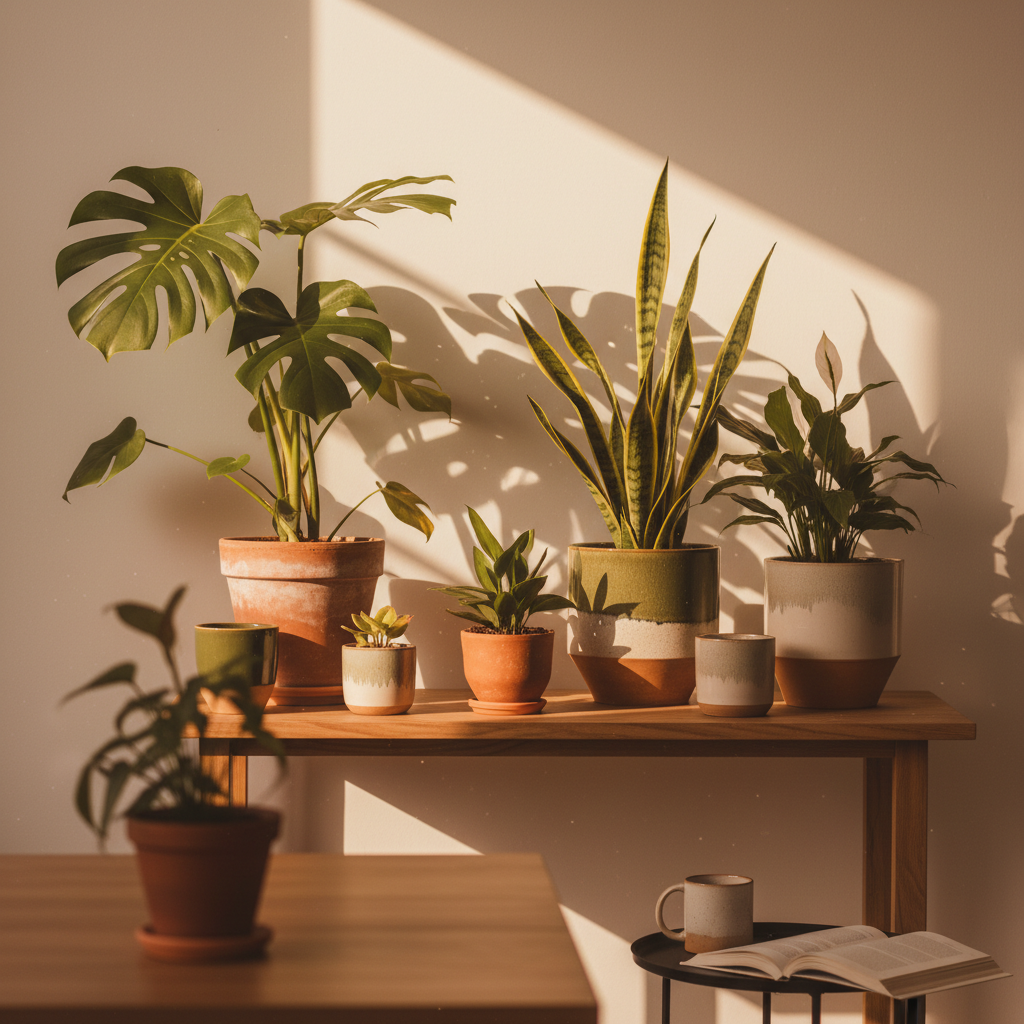
It’s 3pm in February, the heat’s blasting, and somebody walks into the shop with a sad-looking Monstera and a very confident theory: “I just need more air purifying houseplants.” I hear that at least once a week. The plants aren’t the problem half the time. The room is. Dry air, low light, dusty leaves, and a pot that never quite drains right will beat any trendy foliage plant into submission.
Do air purifying houseplants actually clean indoor air?
Short answer: yes, but not in the magical way the internet likes to pretend. Plants can absorb some compounds through leaves and roots, and they do contribute to a healthier-feeling room. But if you’re expecting a Spider Plant to replace a fan, an open window, or a decent filter, that’s fantasy.
Most of the real-world benefit in a home comes from the whole setup: less dust on leaves, a little humidity bump, and a room that feels calmer because there’s living green in it. That matters. I won’t dismiss that. But I do push back on the idea that one peace lily on a bookshelf is going to scrub a studio apartment clean.
Side note: customers often blame “bad air” when their plant problem is actually 68°F to 72°F (20°C to 22°C) plus very low light and a potting mix that stays wet for 10 days. The plant isn’t purifying anything if its roots are sulking.
Which plants are worth buying if you want the most value?
If you want dependable air purifying houseplants, I’d start with the ones that tolerate average homes and don’t throw a tantrum the second conditions drift. Snake Plant (Dracaena trifasciata) is still one of the easiest. So is Pothos (Epipremnum aureum), especially if your place has filtered light through a sheer curtain or an east-facing window.
Peace Lily (Spathiphyllum) gets recommended constantly, and for good reason: it’s forgiving and tells you when it’s thirsty by drooping. But it’s not a set-it-and-forget-it plant. In my experience, people overwater it in decorative pots with no drainage, then act surprised when the roots go soft.
For a slightly more upscale pick, Monstera adansonii and Monstera deliciosa both hold up well indoors, though they’re not the same as a tiny variegated Monstera ‘Thai Constellation’ you saw on social media. That cultivar is gorgeous, but it’s not the first plant I’d hand to someone who forgets to water for 2 weeks.
| Plant | Why I’d pick it | Watch out for |
|---|---|---|
| Snake Plant | Tough, upright, low fuss | Overwatering in winter |
| Pothos | Fast growth, easy pruning | Leggy vines in low light |
| Peace Lily | Clear thirst signals, glossy leaves | Root rot in heavy soil |
| Rubber Plant (Ficus elastica) | Big leaves, good presence | Leaf drop after sudden moves |
What kind of light, water, and pot do they need?
This is where most people lose the plot. Air purifying houseplants don’t need fancy misting or daily pep talks. They need the right pot, a sane soil mix, and enough light to keep photosynthesis going. For most of the plants above, I like a chunky mix: potting soil with bark and perlite, not straight heavy soil that turns into sludge.
For pots, I’m opinionated: drainage holes matter more than matching your sofa. A ceramic cachepot is fine if the nursery pot can drain inside it. Terracotta is useful for people who tend to overwater because it sheds moisture faster. A 6-inch pot is often plenty for a young plant; jumping to 10 inches because you “want room to grow” usually just keeps the roots wet too long.
Watering depends on the room. In a 65°F to 78°F (18°C to 26°C) home, a Pothos may dry in 7 to 10 days near a window, while a Snake Plant in a cooler 60°F to 68°F (16°C to 20°C) room might go 2 to 3 weeks. Don’t water by calendar alone. Check the top 2 inches, or roughly 5 cm, with your finger. If it still feels cool and damp, wait.
Humidity matters too. Around 40% to 55% is fine for most of these. If your place drops below 30% in winter, you’ll see browning tips and slower growth. That’s not the plant being dramatic. That’s dry air.
How many plants would you need for a real difference?
Here’s the part that annoys people who want a neat number: there isn’t one magic count. A few air purifying houseplants can improve the feel of a room, but they won’t replace ventilation. If your bedroom is 120 square feet and sealed tight, one fern won’t suddenly make it pristine. Open a window when weather allows. Use a fan. Clean the dust. That’s the boring truth.
What plants do well is stack small benefits. A cluster of three to five medium plants near a south- or east-facing window can make a room feel fresher and more alive than one lonely specimen on a dark shelf. I’ve noticed customers get the best results when they treat plants as part of room care, not as a substitute for it.
One practical benchmark: if you can keep a plant healthy for 6 to 8 weeks after bringing it home, you’re probably matching the plant to the space correctly. If it’s declining in 10 days, the room or the potting setup is the issue. I tried pushing a Bird’s Nest Fern into a dry office once, and it did not cooperate. Some plants just won’t fake it.
Key Takeaway
Air purifying houseplants help most when the plant, pot, and room conditions all make sense. Healthy roots beat hype every time.
Which myths about air purifying houseplants should you ignore?
Most guides say “the more plants, the better.” I disagree because that advice skips the part where plants have to survive your actual home. Ten stressed plants don’t outperform three healthy ones. Another myth: misting solves dry air. It doesn’t, at least not for long. A quick mist dries fast and does almost nothing for room humidity.
And no, brown tips don’t always mean “needs more water.” Sometimes the problem is fluoride in tap water, fertilizer buildup, or a pot that’s staying soggy at the bottom while the top looks dry. That’s why I always tell customers to lift the pot. If it feels heavy 4 days after watering, something’s off.
One more: not every plant labeled “air purifying” is a great home plant. Some look gorgeous in a greenhouse and miserable on a windowsill in January. Your mileage may vary, but if you’re choosing between a finicky novelty plant and a sturdy Pothos, I know which one I’d send home with a beginner.
What should you buy first if you’re starting from scratch?
Start with one plant that matches your light, then add another only after you’ve kept the first one happy for a month or two. If your room gets two hours of direct morning sun, a Pothos or Rubber Plant can do well. If it’s more of a north-facing window with soft, indirect light, Snake Plant and Peace Lily are safer bets.
My practical starter list is simple: one Snake Plant in a 6- or 8-inch pot, one Pothos in a hanging basket, and one Peace Lily if you want a plant that gives obvious signals. Use a potting mix that drains in under 15 seconds when watered from the top. If it puddles for minutes, change the mix.
At the shop, I see the same pattern over and over: people buy the prettiest plant first, then try to force their home to fit it. Flip that around. Match the plant to the room, not the other way around. That’s the whole game.
| If your home has… | Start with… | Avoid… |
|---|---|---|
| Low light and dry air | Snake Plant | Ferns and thirsty calatheas |
| Filtered light and steady temps | Pothos | Overpotting in large containers |
| Good window light and room to water | Peace Lily | Letting it sit in standing water |
Q: Do air purifying houseplants need fertilizer to work?
A: Not to “work,” but healthy growth helps them stay vigorous. A balanced liquid fertilizer at half strength every 4 to 6 weeks in spring and summer is plenty for most indoor plants. Skip feeding in winter if growth slows.
Q: Can one plant improve a whole bedroom?
A: It can improve how the room feels, especially if it’s a healthy, leafy plant near a window. But for actual air exchange, ventilation still matters more than plant count.
Q: Which plant do customers overwater the most?
A: Peace Lily, hands down. People see a droop and panic-watering starts. Wait until the pot lightens and the top layer dries; don’t keep the mix wet all week.
Pick one plant that fits your light, use a pot with drainage, and forget the hype about miracle cleanup from air purifying houseplants.
Related reading
Sources: co2meter.com, swansonsnursery.com, sciencealert.com