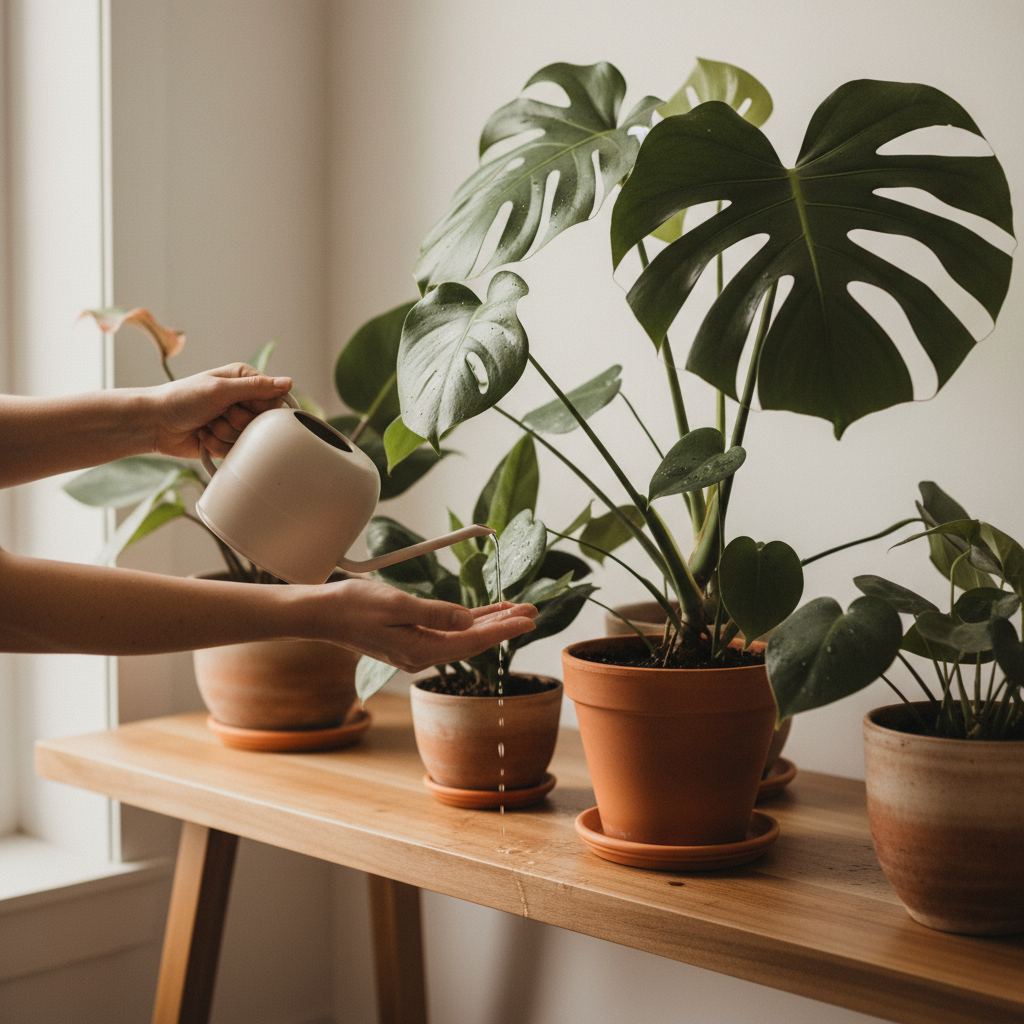
I weighed three Monstera pots over 14 days and the one in a 10-inch terracotta pot lost water almost twice as fast as the one in plastic. That lined up with what I’ve seen after killing more houseplants than I care to admit, including three philodendrons I rotted before I figured this out. Monstera watering looks simple until the leaves droop, the soil stays soggy, and you realize the plant was trying to tell you something for a week.
1. Read the soil, not the calendar
The biggest mistake is watering Monstera deliciosa on a fixed schedule. Honestly, the plant does not care that it’s Tuesday. It cares whether the mix has dried enough for oxygen to get back to the roots. Most guides push a neat weekly routine, but I’m not convinced that works in a north-facing window in January or a sunny east-facing window in July.
My rule is basic: check the pot, then decide. If the top 2 in / 5 cm are dry, I water. If the pot still feels heavy, I wait. In a 6-inch pot, that can mean 5 days in summer or 12 to 14 days in winter. In a 10-inch pot, it may stretch longer. Your mileage may vary, especially if your mix is chunky or your room sits at 68°F to 78°F (20°C to 26°C).
What “dry enough” actually looks like
Stick a finger down 2 inches, or use a wooden chopstick if your nails are too short like mine. If it comes out cool and damp, skip watering. If it comes out mostly clean and the pot feels light, go ahead. Side note: a cheap moisture meter can help, but I trust the pot weight more than the gadget.
2. The watering schedule that finally worked for me
For a healthy Monstera, I water deeply, then let the plant move through a real dry-down cycle. That means pouring until water runs from the drainage holes, then emptying the saucer after about 10 minutes. A plant in active growth might need that every 7 to 10 days; one in a cooler room around 65°F to 70°F (18°C to 21°C) may only need it every 2 weeks.
This is where people overdo it. They give 100 mL here, 150 mL there, and keep the root zone half-wet forever. I’d rather water thoroughly once than dribble 3 small sips over 4 days. That might sound controversial, but half-watering is how you get shallow roots and weird yellowing.
One exception I actually like
If the plant is in a chunky mix with bark and perlite, and the room is hovering around 72°F (22°C), I sometimes wait until the leaves lose a touch of stiffness before watering. Not wilted. Just less perky. That tiny delay has saved me from overwatering more than once.
3. Pot, light, and room conditions change everything
Monstera watering is really a three-part puzzle: pot material, light, and indoor climate. A terracotta pot dries faster than plastic, sometimes by 1 to 3 days. A plant 2 feet from an east-facing window may drink faster than one tucked 8 feet back from the glass. A Monstera ‘Thai Constellation’ often seems even fussier about staying evenly moist, probably because variegated leaves grow a bit slower and don’t forgive mistakes as quickly.
Humidity matters too. Around 40% to 60% humidity is comfortable for many homes, but if your place drops to 30% in winter, the plant can dry out faster on top while the root ball stays wet below. That’s how people get fooled. The surface looks crusty, so they water again, and the lower half never gets a chance to breathe.
If your home is chilly, around 60°F to 65°F (16°C to 18°C), back off. If it’s sitting near 80°F (27°C) with strong filtered light, the plant may ask for water sooner. I haven’t figured out why one Monstera in my house drinks like a camel while another sulks for 11 days, but the pot size and light level are usually the clue.
4. How much water to give without being dramatic
For a medium Monstera in a 7- to 8-inch pot, I usually pour 500 to 900 mL slowly, stopping when runoff appears. For a larger plant in a 10-inch pot, it can take more. The point isn’t the exact number. It’s making sure the whole root ball gets wet, not just the top layer.
Use room-temperature water, roughly 68°F to 75°F (20°C to 24°C). Ice-cold water is unnecessary and, in my experience, just makes the plant unhappy for no good reason. If your tap water is heavily treated, let it sit for 24 hours first, or use filtered water if the leaves keep getting crispy edges.
I also like to water in the morning, especially in winter. That gives the plant 8 to 10 hours of light and warmth to use the moisture before night cooling slows everything down. It’s a small thing, but small things add up.
5. The signs you’re watering too much or too little
Overwatered Monsteras often show yellowing leaves, a sour smell from the pot, and stems that feel soft near the soil line. Underwatered plants usually look droopy, with curling leaves and a pot that feels feather-light. The annoying part is that both can look “sad,” which is why guessing is a bad strategy.
Here’s a quick comparison:
| Signal | Likely issue | What to do |
|---|---|---|
| Yellow lower leaf + wet soil | Too much water | Wait, improve drainage, check roots |
| Droopy leaf + dry pot | Too little water | Water deeply until runoff |
| Brown crispy edges + low humidity | Dry air or inconsistent watering | Stabilize moisture, aim for 40%+ humidity |
If the plant is rootbound, water can rush straight through in under 5 seconds and still leave the center dry. That’s when repotting into a mix with bark, perlite, and quality potting soil makes more difference than any “schedule.”
Key Takeaway
Water Monstera after the pot has dried down, not by the calendar. Check soil depth, pot weight, and room conditions together.
Q: How often should I water Monstera deliciosa?
A: Usually when the top 2 inches are dry, which might be every 7 to 10 days in summer or closer to 2 weeks in a cooler room. The plant, pot, and light level decide more than the calendar.
Q: Should I mist my Monstera instead of watering it?
A: No. Misting doesn’t water the roots, and roots are the whole game. If humidity is low, a pebble tray or humidifier helps more than spraying the leaves.
Q: What’s the fastest way to tell if I’m overwatering?
A: Check for a heavy pot, soggy mix, and yellowing lower leaves. If the soil still feels damp after 7 days and the plant looks droopy, stop watering and let it dry out.
Bottom line: the best monstera watering routine is the one that responds to the plant, not the app on your phone.
Related reading
Sources: thesill.com, intuitiveplants.org, plantproper.com, soltech.com, planethouseplant.com