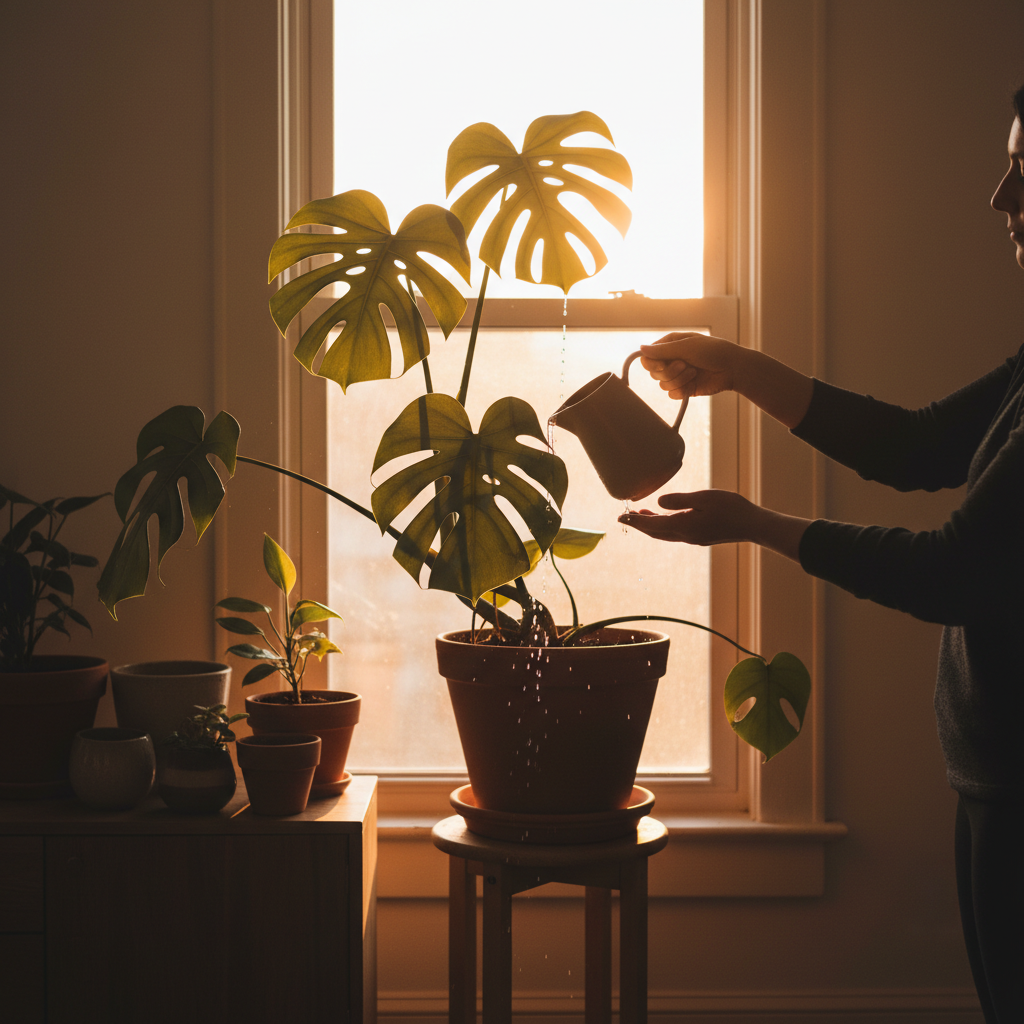
Overwatering causes more Monstera problems than underwatering, and root rot can start after just 24 to 48 hours of soggy soil. I’ve watched a healthy Monstera deliciosa go from glossy to floppy in one badly timed soak, and the fix was less “more water” than “better timing.”
Monstera watering gets easier once you stop treating it like a calendar task and start reading the plant, the pot, and the room. That shift usually saves leaves, and it also saves you from the cycle of panic-watering after every droop.
1. Read the soil before you reach for the can
The simplest rule is still the best one: water only when the top layer has dried. For most indoor Monsteras, that means checking the top 2 inches, or about 5 cm, with a finger or chopstick. If it feels cool and damp, wait. If it feels barely moist and the pot is noticeably lighter, it’s time.
Most guides say to water on a strict schedule. I disagree because room conditions change too much. A plant in a north-facing window with 45% humidity may dry in 8 days, while the same pot near an east-facing window and a vent can need water in 4 to 5 days. In my experience this works for Monstera deliciosa much better than for Monstera adansonii, which tends to want a slightly more even rhythm.
Side note: if the top looks dry but the lower half of the pot still feels heavy, don’t rush. That’s how people end up creating a wet core and a dry crust.
2. Match watering to the room, not the myth
Room temperature matters more than most care cards admit. Monsteras usually stay comfortable around 65-80°F (18-27°C), and evaporation slows down once you dip below 65°F (18°C). In a cooler room at 68°F (20°C), I’d expect slower drying than in a space holding 74°F (23°C) with moving air.
Humidity changes the math too. Penn State Extension notes that indoor humidity often drops in heated homes, and that dry air can speed moisture loss from potting mix. A Monstera near 30% to 40% humidity may need water sooner than one sitting at 50% to 60%, even if both get the same light.
What I do with different light levels
Near a bright east window with 2 hours of direct morning sun, I check every 4 to 6 days. In a softer spot with filtered light through a sheer curtain, it’s closer to 7 to 10 days. A plant under stronger light and a fan can dry fast enough that a 6-inch pot needs a drink before the week is out. That’s normal, not failure.
3. Use the pot size and mix as your cheat code
Pot volume changes everything. A 4-inch pot can dry in 3 to 5 days, while an 8-inch pot may hold moisture for 10 to 14 days. The same plant, same house, different container, completely different watering pattern.
Drainage matters just as much as size. A chunky mix with bark, perlite, and coco coir sheds water faster than a dense peat-heavy mix. If your pot has no drainage hole, Monstera watering becomes guesswork with a bigger chance of rot. I’d rather use a smaller pot with a hole than a decorative cachepot that traps 150 ml of excess water at the bottom.
For a plant like Monstera ‘Thai Constellation’, which can be slower-growing indoors, I lean conservative. It doesn’t need constant moisture; it needs oxygen around the roots. That’s the part most people miss.
4. Water deeply, then let it breathe
When you water, do it thoroughly. Pour until you see runoff from the drainage hole, then empty the saucer after 5 to 10 minutes. For a medium 6-inch pot, that may be roughly 300 to 500 ml, though the exact amount depends on your mix and root mass.
Deep watering encourages roots to grow through the pot instead of clustering at the top. Shallow sips can leave the lower root zone dry while the surface stays damp enough to fool you. That’s one reason leaves can still droop even when the topsoil looks “fine.”
I tried the mist-and-move-on approach first, and it didn’t work. The plant looked thirsty, but the root ball never got an even soak. A full watering, followed by a real drying period, fixed that in about 2 weeks.
Seasonal rhythm matters
In summer, many indoor Monsteras want water every 5 to 8 days. In winter, when growth slows and light drops, the same plant may stretch to 10 to 14 days. If your home sits around 70°F to 72°F (21°C to 22°C) but the pot is near a cold window at night, the drying pattern can still shift by several days.
5. Watch for the signs that mean “stop” or “go”
Yellowing lower leaves, a sour smell, and a pot that feels heavy for days are classic signs of too much water. Brown crispy edges, curling leaves, and a pot that feels feather-light point in the other direction. Neither set of symptoms means “water on Sunday.” It means inspect the roots, the mix, and the last watering.
A useful habit is to note the date and amount. If you watered 400 ml on Monday and the soil is still wet on Friday, your mix is holding too much water. If the plant is bone-dry in 48 hours, you may need a larger pot, more organic matter, or a room with less direct sun.
Key Takeaway
Monstera watering works best when you combine soil feel, pot weight, and room conditions instead of relying on a fixed weekly schedule.
6. A quick comparison that keeps mistakes small
Here’s the shorthand I use when I’m deciding whether to water. It’s not perfect, but it’s far better than guessing. The main point is to match the plant’s pace to the environment, not to the day of the week.
| Condition | Typical dry-down | What to do | Risk if ignored |
|---|---|---|---|
| East-facing window, 45%-55% humidity | 4-6 days | Check soil twice a week | Fast underwatering |
| North-facing window, 30%-40% humidity | 7-10 days | Water only after top 2 inches dry | Slow rot if overwatered |
| Winter room at 68°F (20°C) | 10-14 days | Use less water, more patience | Soggy roots |
| Chunky mix in a 4-inch pot | 3-5 days | Monitor closely | Sudden dry stress |
One small caveat most guides skip: a plant that was recently repotted may drink differently for 2 to 3 weeks while roots recover. Don’t assume the old schedule still applies.
Q: Should I water Monstera from the top or bottom?
A: Top watering is usually better for a Monstera because it flushes salts through the mix and wets the whole root zone. Bottom watering can work in a pinch, but if you do it every time, the upper mix may stay too dry while the lower roots sit in moisture too long.
Q: How do I know if my Monstera is thirsty or overwatered?
A: Thirsty plants usually feel light, with drooping but not mushy leaves. Overwatered plants often feel heavy, stay damp for days, and may show yellowing lower leaves. If the soil smells sour after 24 to 48 hours, stop watering and check drainage.
Q: Does Monstera adansonii need the same watering as Monstera deliciosa?
A: Not quite. In my experience, Monstera adansonii can prefer a slightly more even moisture pattern, while Monstera deliciosa tolerates a bit more drying between waterings. Your pot, light, and humidity still matter more than the species label alone.
Bottom line: Water your Monstera when the soil says so, not when the calendar does. What’s the driest your pot has ever gotten before you finally trusted it?
Related reading
Sources: livelyroot.com, epicgardening.com, spiderfarmer.eu