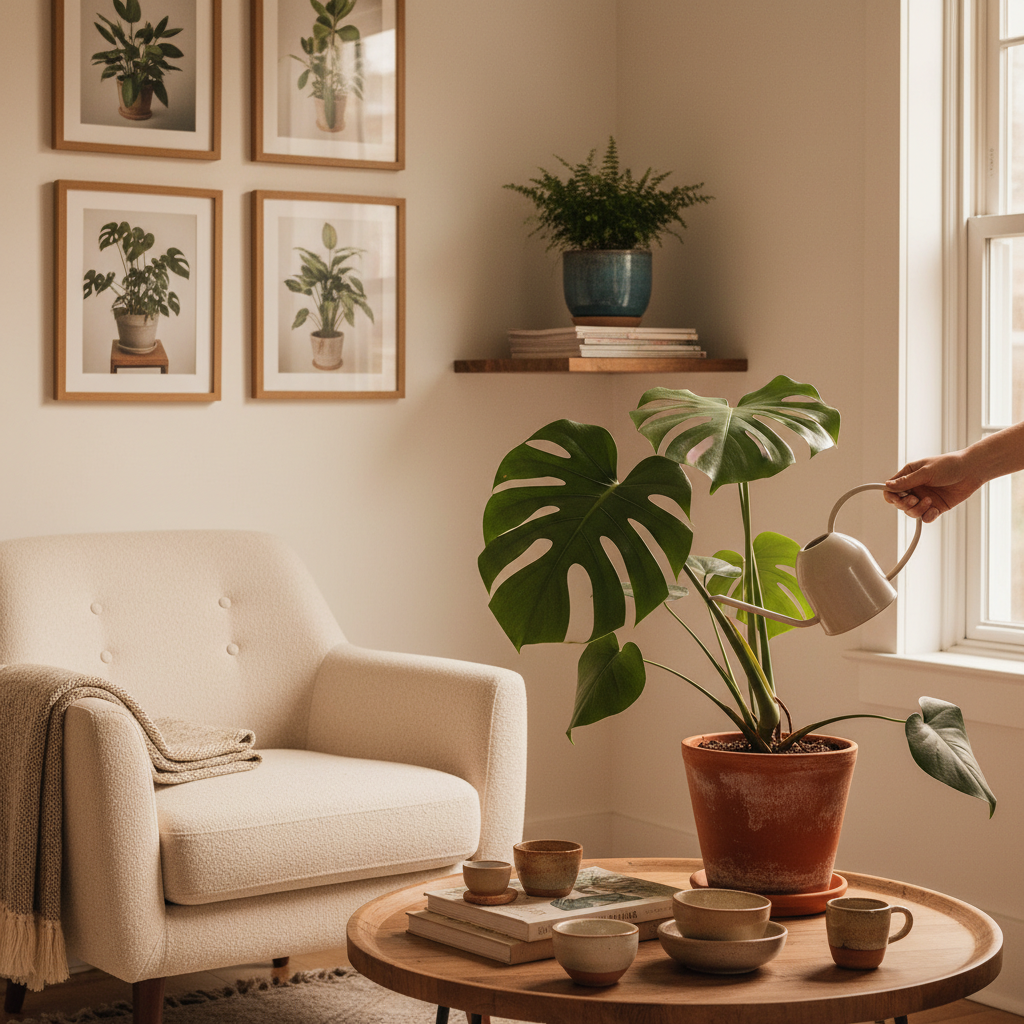
Stop using a moisture meter as your only guide for monstera watering. Honestly, those gadgets made me overthink everything and, for a while, I rotted three philodendrons before I figured this out: the plant, the pot, and the room matter more than the little probe. A Monstera deliciosa doesn’t want a heroic soak on a schedule. It wants a soak only when the mix has actually dried enough to breathe.
How do you know when a monstera actually needs water?
Forget the calendar for a second. The fastest way to stop overwatering is to check the pot itself. If the top 2 inches of soil still feel cool and clingy, wait. If they’re dry and the pot feels noticeably lighter, that’s your cue.
I’m not convinced “water every Sunday” is useful advice for monstera watering. A plant in a 10-inch terracotta pot near an east-facing window can dry out in 5 to 7 days in summer, while the same plant in a plastic nursery pot in a cooler room may take 10 to 14 days. That swing is normal. Side note: if your soil stays wet for more than 4 days after watering, the mix is probably too dense.
Leaves tell on you, too. A thirsty monstera may droop, curl slightly, or stop pushing new growth. But yellowing lower leaves and a sour pot smell usually point to too much water, not too little. I’ve had better luck trusting the pot weight and the top layer than any meter reading.
For Monstera deliciosa, Monstera adansonii, and Monstera ‘Thai Constellation’, the rule is the same: water thoroughly, then let the mix dry partway. Not bone-dry. Not swampy. Somewhere in the middle, which is annoyingly unsexy but true.
What kind of watering routine works in real homes?
Here’s the boring answer that works: water until a bit drains out the bottom, then empty the saucer after 10 to 15 minutes. For a 6-inch pot, that might be around 300 to 500 ml. For a 10-inch pot, it can be more like 700 ml to 1 liter, depending on your mix and how rootbound the plant is. You don’t need to hit an exact number every time, but you do need to water evenly so the roots don’t stay dry in one pocket and soaked in another.
Most guides say to mist a monstera. I disagree because misting barely touches root hydration and can make people feel productive while the soil is still wrong. Give the roots the water, not the leaves. If the room sits around 65-75°F (18-24°C), growth is usually steadier and the plant may dry faster than it does in a 60°F (16°C) corner.
The room changes everything
A monstera in a north-facing window often needs less water than one under an open skylight or near a bright east window with a few hours of direct morning sun. Humidity matters too. Around 40-60% humidity is comfortable for many homes, but a plant in 30% humidity will often dry faster and may need checking every 5 to 8 days. In a humid bathroom at 70% humidity, the same plant may stay moist much longer. Your mileage may vary, and that’s not a cop-out.
After 14 months with my Monstera deliciosa, the pattern finally clicked: smaller pots dry faster, chunky mixes dry faster, and warmer rooms speed everything up. I still check by hand first. The meter gets to sit there looking smug.
| Situation | Likely watering pace | What to check |
|---|---|---|
| East-facing window, 68-75°F (20-24°C) | About every 7-10 days | Top 2 inches dry, pot feels light |
| North-facing window, 60-68°F (16-20°C) | Every 10-14 days | Soil dry deeper than the surface |
| Very airy mix, 40-50% humidity | 5-8 days in active growth | Drainage is fast, leaves perk up after watering |
What should you change if the leaves are drooping or yellow?
Drooping can mean underwatering, but on monstera watering it’s often a timing issue, not a thirst emergency. If the soil is wet and the leaves are limp, back off. If the soil is dry and the leaves are soft, water deeply and give it 12 to 24 hours. The plant usually perks up if you caught it in time.
Yellow leaves are trickier. One lower yellow leaf every now and then is normal aging. Several yellow leaves, a mushy stem, or soil that still feels wet after 3 or 4 days points to root stress. That’s when I’d check drainage holes, trim dead roots if needed, and repot into a chunkier mix with bark, perlite, and potting soil. A mix that holds just enough moisture but still drains fast is the whole game.
If you’re growing a Monstera ‘Thai Constellation’, be extra careful. Variegated leaves can’t photosynthesize as efficiently, so the plant is often less forgiving of soggy roots. I’ve had one sit in a 70°F (21°C) room and still sulk because the pot was too big for the root ball. Bigger pot does not equal happier plant. That advice gets repeated way too often.
Quick practical rule: if the pot is still heavy 48 hours after watering, don’t water again. If the soil is dry and the plant is in active growth, water fully and let excess run out. That’s the part most people skip.
Key Takeaway
For monstera watering, trust dry soil, pot weight, and drainage more than a fixed schedule. Water deeply, then wait until the top layer and part of the root zone have dried before you go again.
FAQ
Q: Should I water monstera from the top or bottom?
A: Top watering is usually better because it flushes salts through the pot and wets the whole root ball evenly. Bottom watering can work in a pinch, but I use it sparingly.
Q: How much water should I give a monstera?
A: Enough that water runs from the drainage holes, then stop. For many 6-inch pots, that’s roughly 300 to 500 ml; larger pots need more.
Q: Can I water monstera on a schedule year-round?
A: You can, but I wouldn’t trust it alone. In winter, a plant in 60-65°F (16-18°C) conditions may need much less water than it does in summer.
Water the roots, not the calendar, and your monstera will usually stop acting dramatic.
Related reading
Sources: spiderfarmer.eu, livelyroot.com, thesill.com