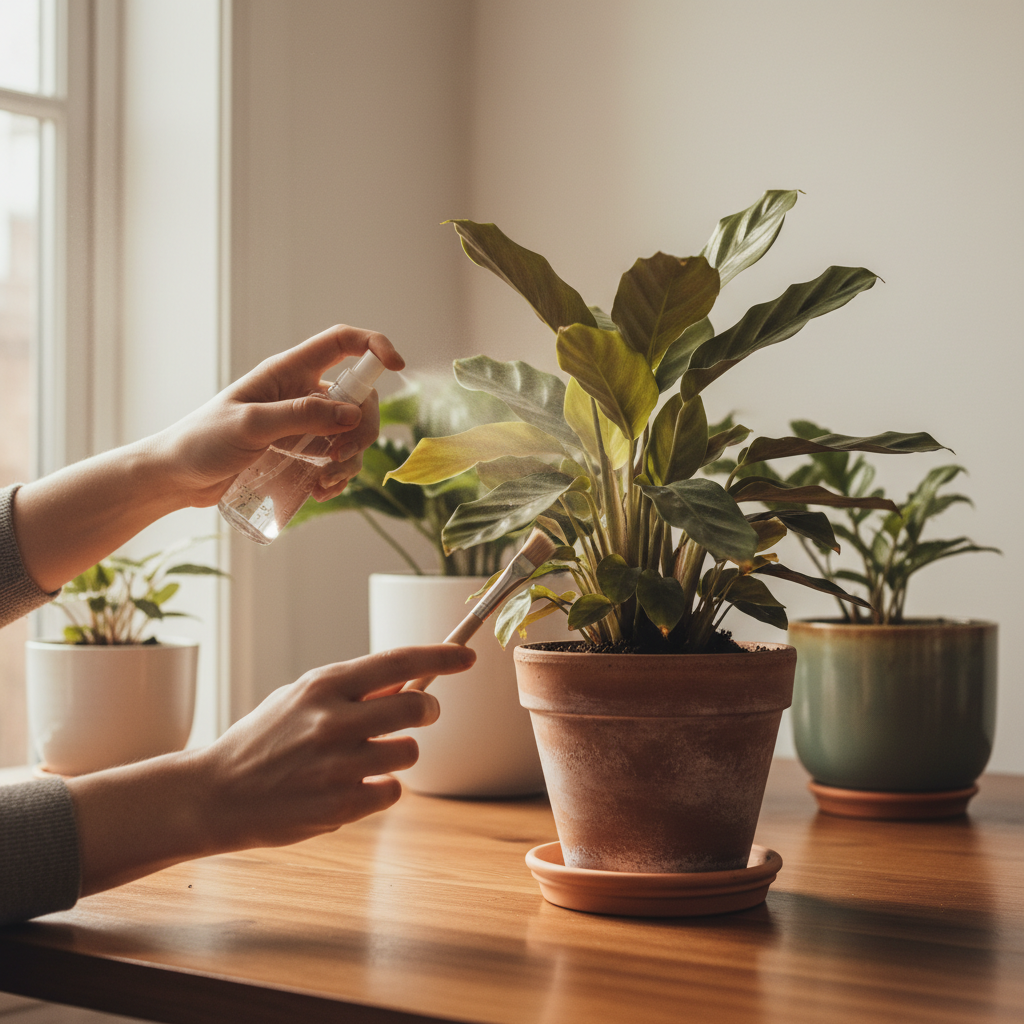
I weighed three Monstera pots over 14 days and the one with fungus gnats barely changed in weight, which told me more than any internet “poke the soil” advice ever has. At the shop, the same pattern shows up all year: people spray once, feel relieved for two days, then the pests come back like they never left. Houseplant pest control only works when you treat the plant, the pot, and the room as one system.
Day 1: The Monstera that came in with moving soil
On a Tuesday in March, a customer brought in a Monstera deliciosa with soil that looked like it was twitching. Not dramatic, just enough fungus gnats to make you stop talking mid-sentence. The plant had been sitting in a north-facing window, about 2 feet from the glass, in a plastic nursery pot inside a ceramic cachepot. That combo matters. Plastic holds moisture longer, and cachepots hide the runoff people forget to dump.
I unpotted it and found a peat-heavy mix that stayed wet for 11 days straight at 68°F to 72°F (20°C to 22°C). That’s gnats’ dream housing. Most guides tell people to mist the leaves or use a random spray. I disagree. That’s treating the symptom, not the nursery tray full of larvae. Side note: if the top looks dry but the pot feels heavy, trust the weight, not the surface.
What I changed first
The first move was boring: remove the plant, dump the old mix, and wash the pot with hot soapy water. Then I repotted into a chunkier blend with bark, perlite, and a small amount of coco coir so it wouldn’t collapse into mud. I also set yellow sticky cards near the pot and one by the nearby fern, because pests don’t always stay loyal to one plant.
For watering, I stopped guessing. The pot got 250 ml only after the lower half of the mix dried, which took 8 days in that room. In my experience, that matters more than any “water every Sunday” rule. Your mileage may vary if the pot is terracotta or if the room runs drier than 45% humidity.
Week 1: Why the spray bottle alone kept failing
At least once a week someone brings in a peace lily or a Monstera adansonii and says they’ve already sprayed it twice. Usually they’ve sprayed the leaves, maybe the top of the soil, and called it done. That’s why the infestation returns. Spider mites sit on leaf undersides, thrips hide in creases, and fungus gnat larvae live below the surface where a quick mist won’t touch them.
For spider mites, I’ve had better results wiping leaves with a damp microfiber cloth and then following with insecticidal soap, especially on plants like Ficus elastica and Philodendron hederaceum. For mealybugs, a cotton swab dipped in 70% isopropyl alcohol works on visible clusters, but it won’t solve a hidden colony in a leaf axil unless you repeat it every 3 days for 2 weeks. That repeat part is the part people skip.
Humidity and heat make a difference
Pests move faster in certain rooms. A cabinet shelf near a grow light at 77°F to 80°F (25°C to 27°C) with 60% humidity can turn into a little pest incubator if air doesn’t move. On the other hand, a cooler room around 65°F to 70°F (18°C to 21°C) with decent airflow slows things down enough that treatment has a chance. I’m not saying turn your living room into a greenhouse. I’m saying don’t assume every room behaves the same.
Week 2: The treatment routine that held up
This is where houseplant pest control gets practical. I like a simple sequence: isolate, inspect, clean, treat, repeat. Isolation means moving the plant at least 3 feet from the rest, not just to the other side of the same shelf. Inspection means checking leaf undersides, stems, and the soil line with a small flashlight. Cleaning means removing dead leaves and wiping dust off, because pests love clutter the way dust bunnies do.
For thrips on a Monstera ‘Thai Constellation’ in the shop, I used a combination of physical removal and a labeled horticultural soap, then repeated it after 5 days. The second pass matters because eggs and newly hatched pests don’t show up at the same time. I tried skipping the repeat once on a Calathea, and it came back. That one was on me.
Key Takeaway
Most indoor pest problems aren’t solved by one product. The fix is usually a mix of isolation, mechanical cleanup, and repeated treatment timed to the pest’s life cycle.
Week 3: What I learned from the pots that dried too slowly
Pot choice is not a side issue. Terracotta helps dry-down in a wet room; glazed ceramic and plastic can be fine, but only if your mix is airy enough. A 6-inch plastic pot in a low-light corner will stay wet far longer than the same pot under an east-facing window with two hours of morning sun. That extra moisture gives gnats and root problems a head start.
Here’s the part customers don’t love hearing: overwatering and pest pressure often travel together. Not because water causes insects, but because soggy soil weakens roots and keeps the whole pot environment favorable to pests. I’ve repotted thousands of plants, and the worst infestations usually show up in the saddest, slowest-drying pots. Not always, but often enough to make me suspicious.
| Pest | What I check first | What actually helps |
|---|---|---|
| Fungus gnats | Moist soil, cachepots, drainage holes | Dry-down, sticky traps, repotting into airy mix |
| Spider mites | Leaf undersides, fine webbing, stippled leaves | Wiping, soap treatment, repeat applications |
| Mealybugs | Leaf joints, stems, hidden creases | Alcohol swabs, manual removal, follow-up checks |
| Thrips | New growth, silvering, tiny black specks | Isolation, soap or labeled treatment, repeat cycle |
Day 21: The habits that keep pests from coming back
By day 21, the plants that stayed clean had one thing in common: someone was paying attention. Not obsessively, just consistently. A 30-second leaf check once a week catches more trouble than a monthly panic spray. If I’m working with a shelf of plants, I’ll also rotate pots a quarter turn so I can see the hidden side of the leaves.
I keep a small checklist near the sink: inspect new plants for 7 days, quarantine for 2 weeks if they came from a big-box store, dump saucers after watering, and don’t let leaves sit against a wall where air can’t move. That last one sounds fussy. It isn’t. It’s how you keep one problem plant from turning into six.
FAQ
Q: Do neem oil sprays solve houseplant pest control on their own?
A: No. Neem can help in some cases, but it won’t fix bad watering, hidden eggs, or a plant packed too tightly against its neighbors. I use it as one tool, not the whole plan.
Q: Should I throw out a plant with pests?
A: Not always. If the plant is badly weakened, heavily infested, or sharing space with a full collection, sometimes disposal is the cleanest choice. But many plants bounce back if you isolate them and treat them on schedule.
Q: Why do pests keep showing up after I repot?
A: Usually because the infestation was already in the plant, the old mix, or a nearby pot. Repotting helps only if you also remove the old soil, clean the container, and keep checking for 2 to 3 weeks afterward.
Houseplant pest control works best when you stop chasing the visible bug and start managing the whole pot environment.
Related reading
Sources: extension.umn.edu, mgnv.org, costafarms.com, extension.colostate.edu, cedarcide.com