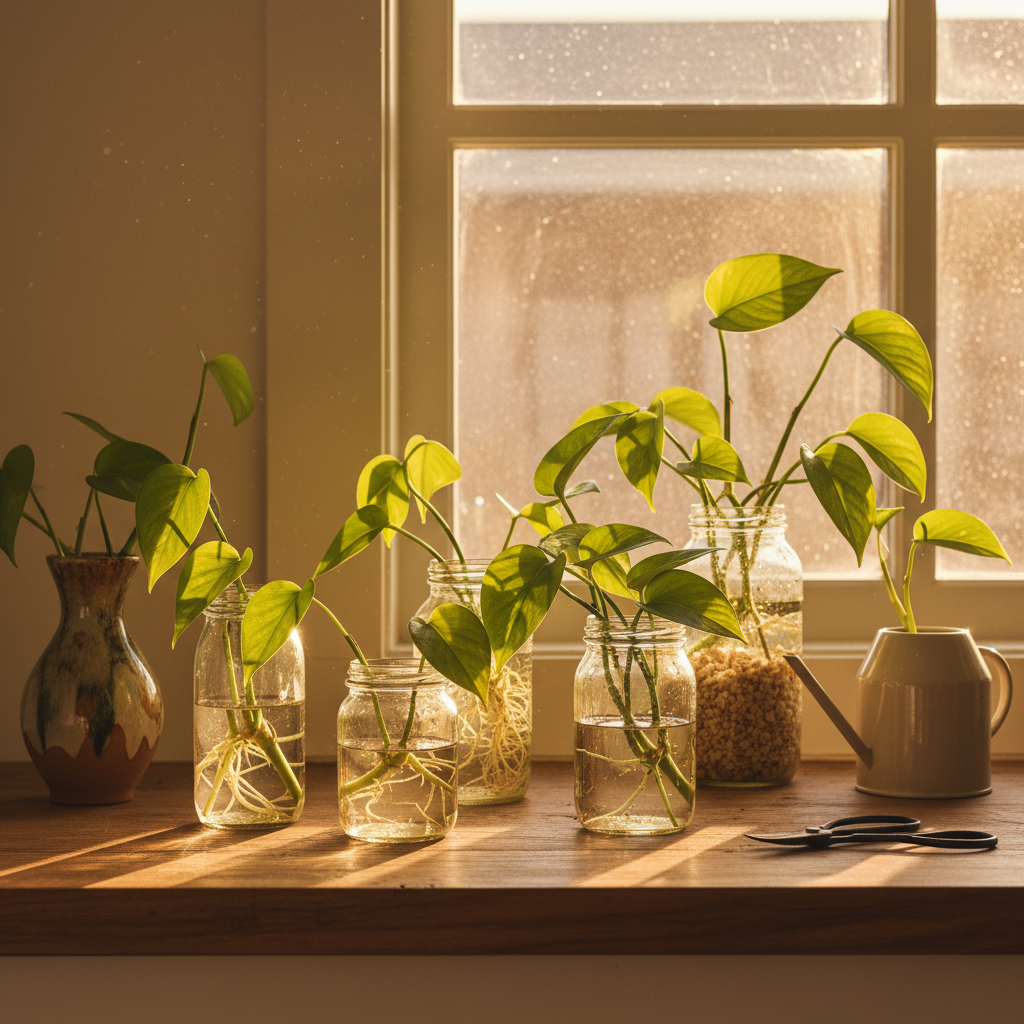
Stop using a moisture meter to decide whether your pothos propagation cuttings are ready. For cuttings, the meter is mostly noise, and I’ve watched more stems rot from overthinking than from being “too dry.” If your pothos vine is long, leggy, or just plain tired, you can turn one plant into several without fancy gear or a greenhouse.
I rotted three philodendrons before I figured this out, and pothos was the plant that finally taught me to keep it simple. Honestly, the trick is less about magic and more about clean cuts, the right node, and not drowning the thing in water like it owes you money.
1. Cut where the plant can actually make roots
Pothos propagation starts with the node, not the leaf. That little bump on the stem is where roots form, and if your cutting doesn’t include at least 1 node, it’s basically decorative. I like cuttings with 2 nodes and 1 healthy leaf, sometimes 3 nodes if the vine is thin.
Use clean snips and cut 0.25 to 0.5 inch below a node. A 4 to 6 inch cutting is usually easier to manage than a giant 12-inch vine flopping around in a jar. If you’re working with Epipremnum aureum like Golden pothos, Marble Queen, or Neon pothos, the process is the same.
Side note: if the stem is mushy, don’t “save” it by cutting lower and lower. Toss that piece. I’m not convinced people talk enough about how often rot wins once it starts.
One more thing that sounds backwards: don’t chase the biggest leaf. A smaller cutting with a firm node is better than a dramatic vine with a weak stem. That’s the part that matters for pothos propagation, not the leaf count.
2. Water rooting without turning the jar into a swamp
Most guides say to keep the node submerged. I disagree, at least partly. Put the node in 1 to 2 inches of water, but keep the leaf above the surface. That’s enough. I use room-temperature water around 68-75°F (20-24°C), and I change it every 3 to 5 days so it doesn’t get stale.
A clear glass works because you can see what’s happening. In my experience, roots usually show up in 7 to 14 days if the cutting is healthy and the room sits around 65-78°F (18-26°C). Cooler than that, and it slows down. Hotter than that, and algae gets ambitious.
Place the jar in filtered light, like an east-facing window or a spot with 2 to 3 hours of gentle morning sun. Avoid harsh afternoon light. That can cook the water and stress the cutting faster than people expect.
If the stem starts to look cloudy or soft, dump the water immediately and recut above the rot. I know that sounds dramatic, but this might be controversial: a fresh cut saves more pothos than constant fussing.
3. Soil rooting when you want stronger plants from the start
Water rooting is easy to watch, but soil rooting can give you sturdier roots sooner. I use a small pot with drainage holes and a mix that drains fast: roughly 2 parts potting soil, 1 part perlite, and 1 part orchid bark. The pot should be about 3 to 4 inches wide for a few cuttings.
Keep the mix lightly moist, not soggy. Think 30% to 40% moisture in the root zone, not wet enough to squeeze water out. At around 70-75°F (21-24°C), soil-rooted cuttings often settle in over 2 to 4 weeks. If the room is closer to 60°F (16°C), expect it to drag.
I like this method for variegated pothos cultivars such as Marble Queen because I’ve had fewer “oops, the stem melted” moments once roots get established. Place the pot near a north-facing window or under filtered light. Too much direct sun dries the top layer fast, and then you end up watering on emotion instead of evidence.
Keep the mix lightly moist for the first 10 to 14 days, then ease off. New growth is the signal that the cutting has grabbed hold.
4. Potting up and spacing cuttings so the plant looks full, not crowded
Once roots are 2 to 4 inches long in water, or once soil-rooted cuttings resist a gentle tug, pot them up. Don’t wait until the roots form a tangled bird nest. That makes transplanting messier and can slow growth for a week or two.
For a fuller plant, tuck 3 to 5 cuttings into one 5-inch pot. If you want a trailing basket, space them around the rim instead of shoving them into the center. That gives you a balanced shape in about 6 to 8 weeks, depending on light and temperature.
After potting, water with about 150 to 250 ml, just enough to settle the mix. Then let the top 1 inch dry before watering again. In a home that stays near 40% to 60% humidity, pothos usually handles the transition fine. Dry winter air is another story, but pothos is still less dramatic than half the plants on my shelf.
Here’s the part people skip: rotate the pot every 7 to 10 days. Otherwise, the side facing the window does all the work and the plant leans like it’s trying to escape.
| Method | Best for | Typical timing | Main watch-out |
|---|---|---|---|
| Water rooting | Beginners and visual learners | 7-14 days for roots | Stale water and stem rot |
| Soil rooting | Stronger transition to potting mix | 2-4 weeks | Overwatering |
| Perlite rooting | Fast drainage and less rot | 10-21 days | Drying out too fast |
| Direct potting of multiple cuttings | Fuller-looking plant | 6-8 weeks for visible fill-in | Overcrowding the pot |
5. The mistakes that slow pothos propagation down
The biggest mistake is using a cutting with no node. Second place goes to putting 6 cuttings in a tiny jar and calling it “efficient.” Third is letting the water sit until it smells like a forgotten vase. None of that helps.
If a cutting stalls for 14 days, don’t panic. Check the node, refresh the water, and move it to a spot with steadier light. If it’s in soil, make sure the mix isn’t packed down like concrete. Pothos roots want oxygen. That part gets ignored all the time.
I have a north-facing window where cuttings root slower but cleaner, and an east-facing sill that speeds things up without scorching the leaves. Your mileage may vary, especially if your place runs cold at night. One apartment I had dropped to 62°F (17°C) and everything moved like it was asleep.
Key Takeaway
The shortest path to successful pothos propagation is this: cut at the node, keep conditions steady, and don’t drown the stem. A healthy cutting in the right light can root fast enough that you’ll forget how much you overcomplicated it the first time.
Q: Should I propagate pothos in water or soil?
A: Water is easier to monitor, especially if you’re new to pothos propagation. Soil can give you a smoother transition later, but only if you keep the mix airy and don’t overwater it.
Q: How long does it take for pothos cuttings to root?
A: In decent conditions, water rooting often shows progress in 7 to 14 days. Soil usually takes 2 to 4 weeks before you feel real resistance from the roots.
Q: Can I root pothos from one leaf?
A: No. You need a node. A leaf alone looks cute in a jar, but it won’t become a new plant.
Bottom line: use a node, keep the water clean, and give the cutting steady light instead of babying it to death.
Related reading
Sources: bwhplantco.com, younghouselove.com, almanac.com, joyusgarden.com