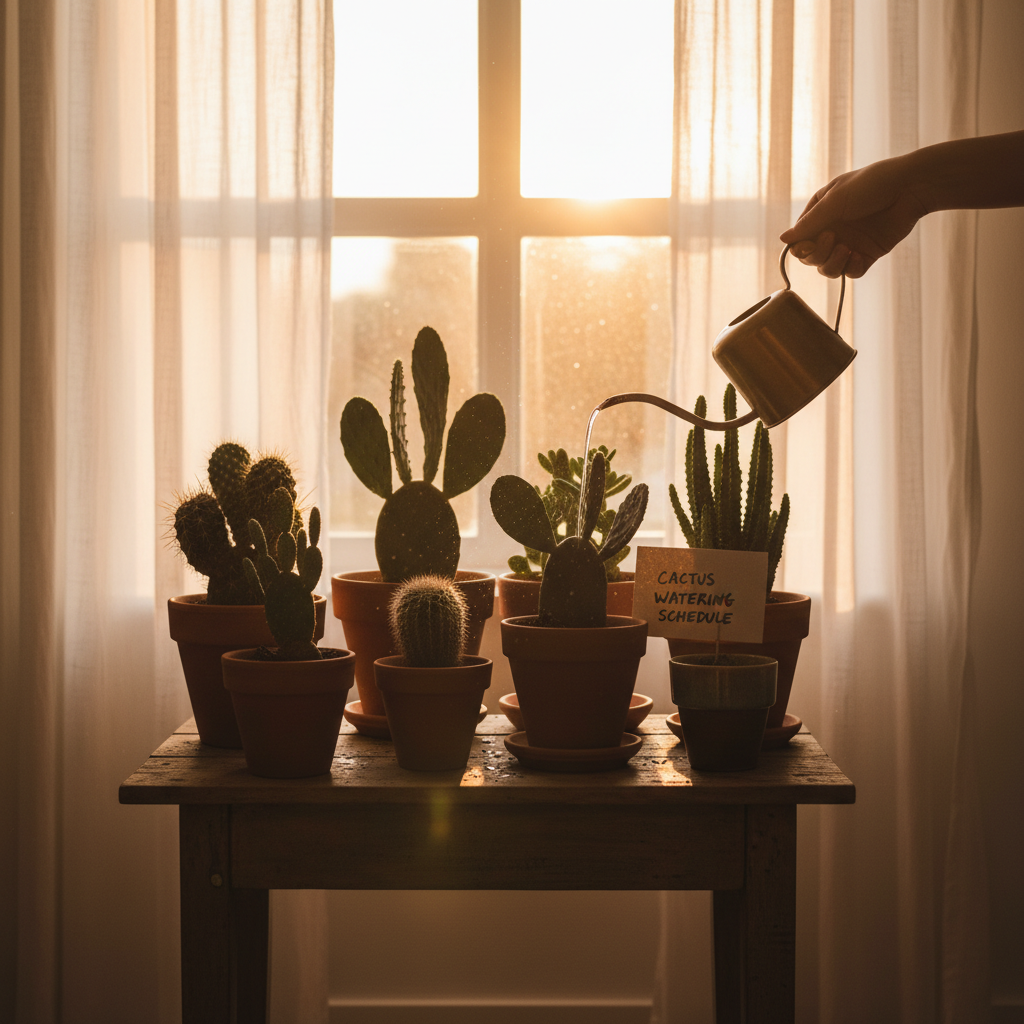
I weighed three cactus pots over 14 days in a 68°F to 74°F room, and the driest one lost just enough water to make the pot feel noticeably lighter by day 9. That’s the part most people miss: cacti don’t want a fixed calendar as much as they want a drying cycle that matches the pot, the soil, and the light.
1. Read the Pot, Not the Calendar
At least once a week someone brings in a cactus that was watered “every Sunday” and it’s either mushy at the base or wrinkled from stress. A cactus watering schedule works better when you check the soil first. If the mix is still cool and damp 2 inches down, don’t pour more in just because it’s been 7 days.
I usually tell people to lift the pot, then check the drainage hole with a wooden skewer. If it comes out with damp crumbs, wait. If it comes out dry and the pot feels much lighter than it did 5 to 10 days ago, that’s your cue. This is especially useful for indoor Mammillaria and Echinopsis, which can sit dry longer than a leafy houseplant.
Side note: terracotta dries faster than plastic, and that changes everything. A 6-inch terracotta pot in a 72°F room can be ready sooner than the same plant in a glazed ceramic pot. That’s not a theory; it’s just physics and porous clay doing its job.
2. Match Watering to Light and Temperature
Cacti in stronger light use water faster, but “stronger” doesn’t mean blasting sun for 10 hours. An east-facing window with 2 to 4 hours of morning sun behaves differently from a south-facing sill behind a sheer curtain. In my shop, plants near glass that sits around 75°F to 80°F often dry faster than the same species on a shaded shelf at 65°F to 70°F.
Here’s the useful part: if your cactus lives in a room around 18°C to 24°C (65°F to 75°F), you may be looking at watering every 10 to 21 days in active growth. In a cooler 60°F to 65°F space, that can stretch longer. Desert steel shelves and sunrooms create the opposite problem: the mix dries fast on top but stays wet in the center if the pot is oversized.
I disagree with the internet advice that says all cacti need “barely any water.” That’s too vague. A healthy Opuntia microdasys in a bright kitchen window needs a different cactus watering schedule than a slow-growing Astrophytum asterias under a grow light. Same genus, different pace.
3. Pick the Right Soil and Pot
The mix matters more than people want to admit. A gritty cactus blend with 50% to 70% mineral material—pumice, perlite, coarse sand, or small lava rock—dries faster and more evenly than a peat-heavy bagged mix. If you use a dense mix, even a careful cactus watering schedule can fail because water lingers too long around the roots.
Pot size matters too. A 4-inch pot can dry in 4 to 7 days under strong indoor light, while an oversized 8-inch pot may stay wet for 2 weeks or more. That’s why I like terracotta for beginners and only recommend decorative cachepots if they have a real drainage setup. No drainage hole, no useful schedule.
For a cactus like Gymnocalycium mihanovichii, I’d rather see a smaller pot and a mineral-leaning mix than a giant container full of moisture-retentive soil. You’ll get a cleaner dry-down and fewer surprises at the base.
4. Adjust by Season and Location
Winter changes the game. In a room that drops to 60°F to 68°F (16°C to 20°C), many indoor cacti slow down enough that watering might shift to every 3 to 5 weeks. In summer, especially in a USDA zone 9 home with a hot bright window, the same plant may want water every 8 to 12 days.
That said, don’t force a summer rhythm onto a winter plant. I’ve seen people keep a strict 14-day routine through January and end up with root rot by February. The plant wasn’t “thirsty”; it was dormant-ish and sitting in cool, slow-drying soil. Most guides say to water on a fixed schedule. I disagree because the room temperature and light level matter more than the calendar.
If your cactus spends part of the year outside, bring it back in before nights stay below 50°F to 55°F (10°C to 13°C). Cold soil plus moisture is a bad mix. Your cactus watering schedule should slow down before the plant does.
5. Use the Right Amount of Water
People overcomplicate this, then under-water or flood the pot. The goal is to wet the root zone, not give the plant a sip. For a 4-inch pot, 120 to 180 ml is often enough. For a 6-inch pot, I usually see 250 to 350 ml do the job, depending on soil texture and drainage.
Water slowly until you see a little runoff, then stop. If the pot sits in a saucer, empty it after 10 minutes. Leaving 30 ml to 50 ml of runoff under the pot is how you turn a dry-loving cactus into a soggy one. If your mix is very gritty, the water may move through fast; if it’s peat-heavy, it may need less volume and more patience.
Don’t mist the cactus. That advice pops up everywhere, and it’s mostly useless for established plants. Misting does almost nothing for root hydration, and on some hairy species it just makes the plant look dusty and damp at the same time.
6. Catch the Warning Signs Early
A good cactus watering schedule is really a damage-prevention system. If the plant starts wrinkling deeply at the ribs after 14 to 21 days in a dry room, that can be normal thirst. If the base turns soft, dark, or smells off, that’s not drought; that’s rot.
Look at the body, not just the top. A healthy cactus may shrink slightly during a dry spell, then plump up within 24 to 48 hours after watering. But if you notice corky spots, yellowing near the soil line, or a stem that wobbles in the pot, the roots may already be struggling. I haven’t figured out why some supermarket cacti arrive with such poor root systems, but they do, and they punish overwatering fast.
One practical example: a customer brought in a Ferocactus that had been watered every 10 days in a dim hallway. The schedule wasn’t the only problem—the light was weak, the pot was too large, and the mix stayed wet for nearly 2 weeks. Fixing one of those things helps. Fixing all three helps a lot more.
7. A Simple Schedule That Actually Works
Here’s the version I’d use for most indoor cacti: check weekly, water only when fully dry, and expect the interval to change with the season. In a typical home at 68°F to 75°F (20°C to 24°C), that often means every 10 to 21 days in spring and summer, then every 3 to 5 weeks in fall and winter. Your mileage may vary, especially if the plant sits under a grow light for 12 hours a day.
| Condition | Typical interval | Water amount | Notes |
|---|---|---|---|
| Bright east window, 70°F to 75°F | 10 to 14 days | 120 to 250 ml | Soil should dry fully between waterings |
| Cool room, 60°F to 65°F | 3 to 5 weeks | 100 to 200 ml | Check the pot weight before watering |
| Hot sunroom, 75°F to 85°F | 8 to 12 days | 180 to 350 ml | Use a gritty mix and a draining pot |
| Low light shelf, 65°F to 72°F | 2 to 4 weeks | 100 to 180 ml | Water less often than you think |
This is the part customers usually like: you don’t need a perfect formula. You need a repeatable check. If the soil is dry, the pot is light, and the cactus looks a touch less full than usual, water it. If not, wait another 3 to 7 days and check again.
8. Common Myths That Keep Cacti Wet
Myth one: cactus watering schedule means a fixed day of the week. Nope. Myth two: a tiny splash is safer than a full soak. Also wrong. A small splash can wet only the top 1 inch, leaving roots dry while the center stays stale. Myth three: all cacti want the same treatment. A slow Astrophytum and a fast-growing Opuntia do not live by the same clock.
Another one I hear all the time: “The soil looks dry, so it must be dry.” Surface dryness lies. In a 5-inch pot, the top can look bone-dry while the lower half is still damp 2 inches down. That’s why I like to use a skewer or lift-test instead of guessing from the top crust.
Key Takeaway
Build your cactus watering schedule around dry soil, pot size, light, and temperature—not a fixed calendar. If you can keep the mix airy, the pot draining, and the interval flexible by 1 to 3 weeks, you’ll avoid most of the rot I see walk through the shop.
Q: Can I water cactus on a fixed weekly schedule?
A: Only if your room, light, pot, and soil happen to dry on that exact pace. Most homes don’t work that neatly, so weekly watering is usually too frequent for indoor cacti.
Q: Should I water less in winter?
A: Yes. In cooler months, many indoor cacti slow down and may only need water every 3 to 5 weeks, especially if the room sits around 60°F to 65°F (16°C to 18°C).
Q: How do I know I’ve watered enough?
A: Water slowly until you see a bit of runoff from the drainage hole, then stop. For a 6-inch pot, that often lands around 250 to 350 ml, but the exact amount depends on the mix and pot material.
Bottom line: check the pot, trust the dry-down, and let the season set the pace—what’s your cactus doing right now?
Related reading
Sources: planetdesert.com, cactusenligne.ca, btarboretum.org, desertsteel.net, lulasgarden.com