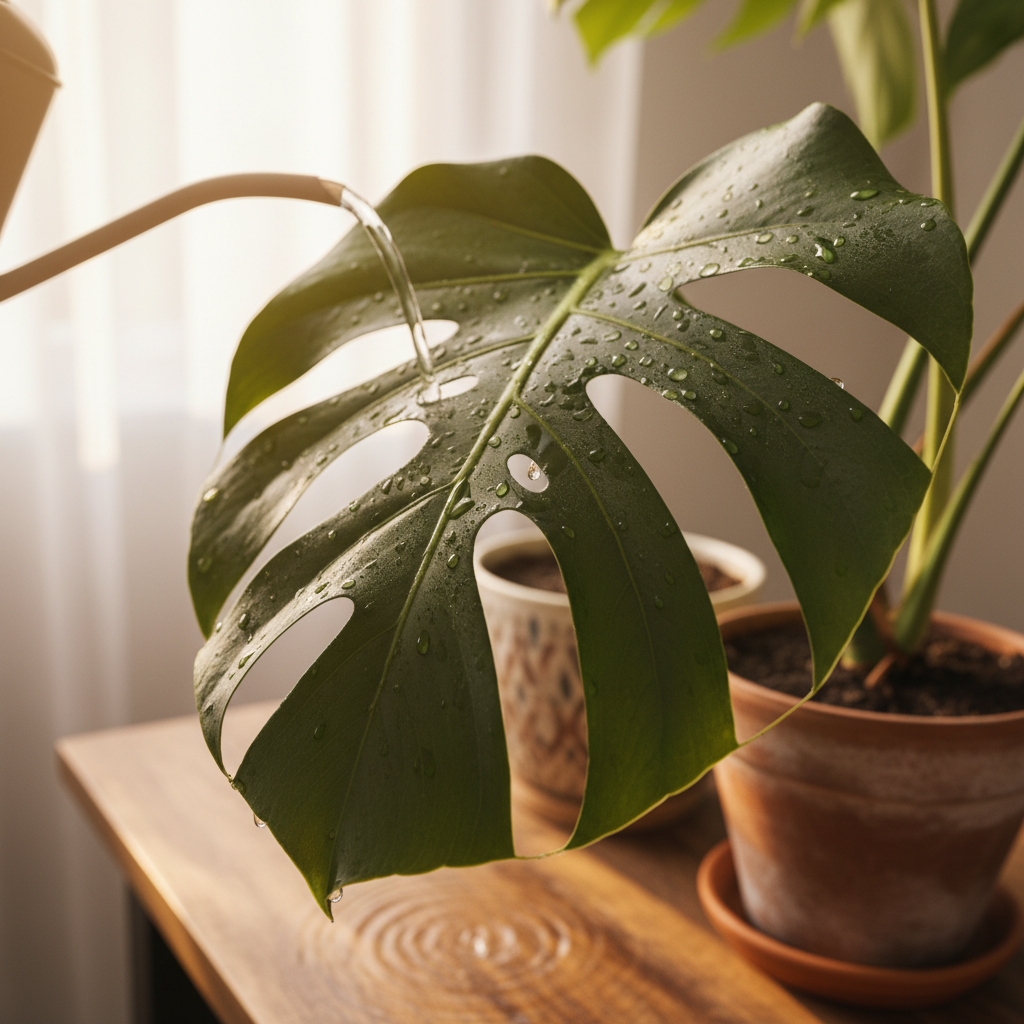
Stop using a moisture meter as your only guide for monstera watering. The number on the screen can look reassuring while the root zone is still soggy, and that’s how a lot of otherwise healthy Monstera deliciosa plants end up with yellow leaves and slow decline. The better move is to read the pot, the soil, and the room together.
1. Read the pot, not the calendar
Most guides want a neat answer like “water every 7 days,” but monstera watering doesn’t work that way in a north-facing window versus a sunny east-facing spot. Spider Farmer notes that watering depends on pot size, light, and season, which is the boring truth—and the useful one. A 6-inch pot dries much faster than a 10-inch pot, and a plant in summer may need attention twice as often as the same plant in winter.
My own Monstera deliciosa in a 10-inch nursery pot usually asks for water around once a week in July, but in January it can go 12 to 14 days before the top layer feels right. In March I noticed the leaves stayed perkier when I waited until the upper 2 inches were dry instead of watering on a fixed schedule. That’s the part most beginners miss: the plant doesn’t care what day it is.
What to check first
Press a finger into the soil and lift the pot. If it feels light and the top 1 to 2 inches are dry, you’re close. If the pot still feels heavy, wait. In my experience this works better for Monstera deliciosa than for Monstera adansonii, which dries faster and sulks sooner if you leave it bone-dry for too long.
2. Match water to light and temperature
Light and temperature change the math fast. Lively Root recommends keeping monstera in the 65–85°F range (18–29°C), and that’s a sensible band for watering decisions too. A plant sitting near a sheer-curtained window at 72°F (22°C) will use water differently than one in a cooler 65°F (18°C) room with lower light. If your home drops to 60°F (16°C) at night, slow down. Roots drink less when the plant is not actively pushing growth.
Humidity matters as well. Around 40% to 60% humidity is a decent indoor target, but I wouldn’t obsess over the exact number unless the leaves are crisping. Side note: a plant on a bookshelf above a heating vent can dry out in 3 days even when the rest of the room feels comfortable.
Here’s the practical version: more light and more airflow mean shorter intervals between waterings; cooler air and lower light mean longer gaps. A Monstera ‘Thai Constellation’ often needs a steadier hand because the variegated leaves grow more slowly and the plant can’t always recover from sloppy watering as quickly.
3. The soil mix that changes everything
Soil is the quiet villain in a lot of monstera watering problems. A dense mix holds water too long, especially in a plastic pot with only a few drainage holes. Spider Farmer and A-Z Animals both emphasize well-draining soil, and that’s not marketing fluff. It’s the difference between a root zone that breathes and one that stays wet for days.
I like a chunky mix with bark, perlite, and a quality indoor potting base. If the mix stays wet for more than 5 to 7 days after watering, it’s probably too heavy for the plant or the pot is too large. A smaller pot can actually be safer than a dramatic oversized one. Monstera roots don’t need a swimming pool.
Small caveat: if your home is very dry, an extra-chunky mix may dry too fast and create a false sense that the plant needs water again when only the top layer has changed. That’s why the lower soil still matters. I tried a super airy blend first and it worked great in summer, then became annoyingly fast-draining in a heated winter apartment.
4. How much water to give without drowning roots
Watering isn’t about a fixed milliliter count, but having a range helps. For a medium 8-inch pot, a slow pour of roughly 400–700 mL is often enough to moisten the root ball without turning the pot into soup. Larger pots may take more, smaller pots less. The goal is even moisture, not a wet bottom forever.
Water slowly until you see a little runoff from the drainage holes, then stop. Wait 10 minutes and empty the saucer. That last step sounds fussy, but it prevents roots from sitting in water. If the pot is bone dry, don’t dump all the water in at once; give it in two passes so the mix can absorb it instead of channeling straight through.
Key Takeaway
Monstera watering works best when you water deeply, then let the soil dry partway before the next round. The plant wants a cycle, not constant dampness.
5. Fixing the mistakes people make most
The biggest mistake is treating yellow leaves as proof of underwatering. Often it’s the opposite. If the soil smells sour, feels heavy after 4 days, or the pot never seems to lighten, you’re probably overwatering. Another common problem is using a moisture meter as a final verdict. I’m not ضد tools, but this one is overrated. It can be useful in a chunky mix and misleading in compact soil.
Watch for drooping that happens while the soil is still wet. That’s not thirst. That’s often stressed roots. On the other hand, if the leaves go soft, the pot is light, and the soil is dry 2 inches down, it’s time to water. The plant is telling you something; the trick is learning which symptom belongs to which problem.
For reference, Penn State Extension-style guidance on container plants generally favors consistent drainage and avoiding saturation, which lines up with what monsteras need indoors. I haven’t figured out why one plant in the same room always drinks faster than the other, but pot material is usually part of the answer. Terracotta can shave a day or two off drying time compared with plastic.
6. A simple routine for real homes
Here’s the routine I’d trust for most homes: check the pot every 4 to 5 days in summer, every 7 to 10 days in shoulder seasons, and stretch to 10 to 14 days in winter if the room stays cool. Keep the plant near an east-facing window or filtered light, maintain roughly 40% to 60% humidity if you can, and adjust for pot size. That’s enough structure without turning plant care into a spreadsheet.
If you’re growing in USDA zone 9 outdoors, the same plant may drink faster in bright shade and wind than it does inside. Indoors, a Monstera deliciosa in a 10-inch pot can behave very differently from a young plant in a 6-inch nursery pot. That’s why the calendar-only method fails. The plant’s environment is the real schedule.
| Situation | What to do | Typical timing |
|---|---|---|
| Summer, filtered light | Water deeply, then let the top 1–2 inches dry | About every 7 days |
| Cool room, lower light | Wait for a lighter pot and drier topsoil | 10–14 days |
| Chunky mix in terracotta | Check more often; it dries faster | 5–8 days |
FAQ
Q: Should I water monstera on a schedule?
A: Use a schedule only as a reminder to check. For monstera watering, the plant’s weight, soil feel, and room conditions matter more than the day of the week.
Q: Can I underwater a monstera on purpose?
A: Brief dryness is usually less dangerous than constant wet soil. But if the leaves are drooping and the pot feels feather-light, don’t wait another 3 days just to prove a point.
Q: What’s the safest sign I’m watering too often?
A: Soil that stays wet for more than 5 to 7 days, a sour smell, and yellowing lower leaves are classic clues. If that’s happening, slow down and improve drainage.
Bottom line: Water your monstera when the pot says it’s ready, not when the calendar does. What does your plant’s pot feel like today?
| Source | Useful point |
|---|---|
| spiderfarmer.eu | Watering depends on pot size, light, and season. |
| livelyroot.com | Monstera does well in the 65–85°F range (18–29°C). |
| a-z-animals.com | Well-draining soil and careful watering reduce root problems. |
Related reading
Sources: spiderfarmer.eu, livelyroot.com, a-z-animals.com