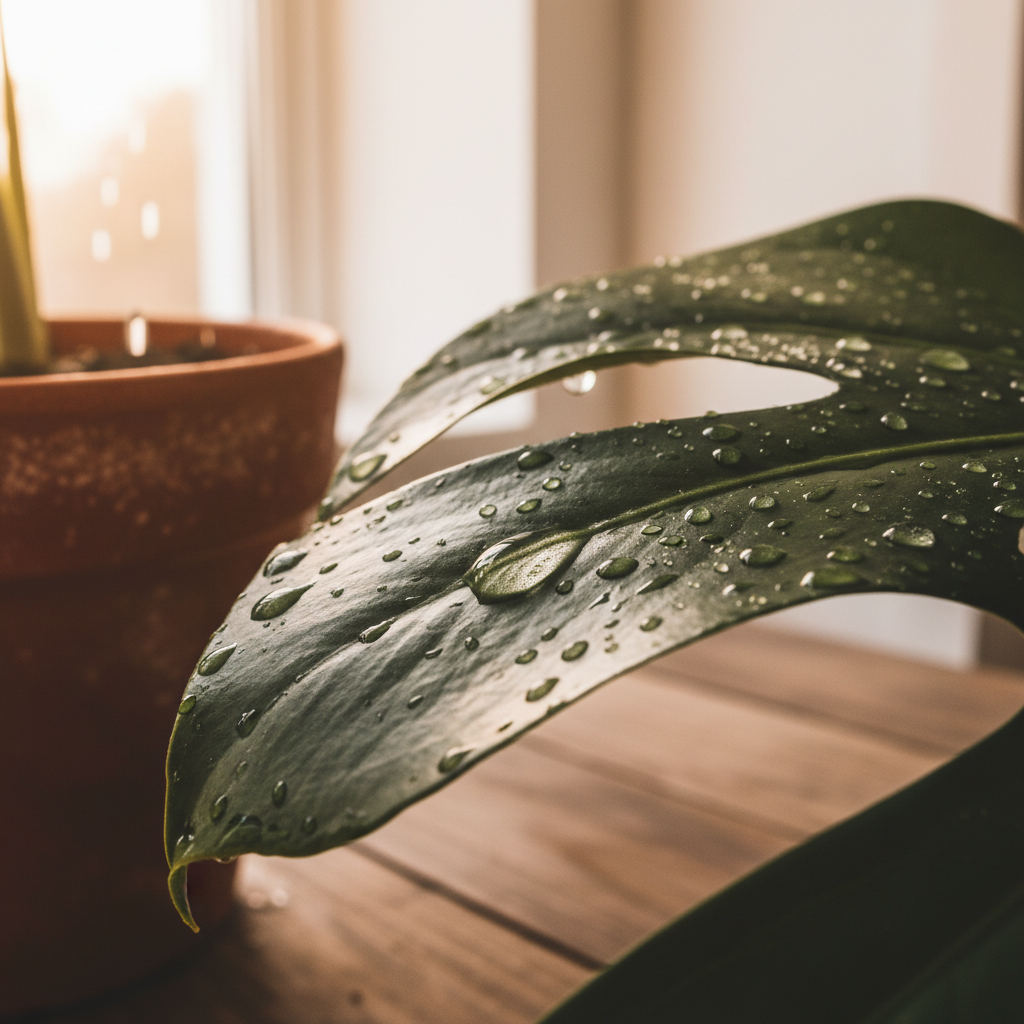
Stop using a moisture meter as your only clue for monstera watering. I’ve watched one “helpful” gadget talk me into soaking a plant that was already sitting in wet mix, and that was how I rotted three philodendrons before I figured this out… honestly, the plant doesn’t care about your gadget if the pot still feels cold and heavy.
Monstera deliciosa is forgiving, but not magical. Get the timing wrong by even a few days in a cool 60°F/16°C room, and the roots can stay soggy long enough to cause trouble; in a 75°F/24°C room with moving air, the same pot may dry much faster. That swing is why watering advice gets people into trouble.
1. Read the pot, not the calendar
The most useful monstera watering habit is boring: lift the pot, poke the top layer, and trust the weight more than the date on your phone. A light plastic pot can dry in 4 to 6 days near an east-facing window, while a heavier ceramic pot in a north-facing window may stay damp for 10 to 14 days.
I’m not convinced by the “water every Sunday” crowd. Most guides act like all homes run on the same schedule, and they don’t. A Monstera deliciosa in USDA zone 9 conditions on a covered patio behaves differently than one under a sheer curtain in an apartment at 68°F/20°C.
Here’s the part people skip: the top 2 inches, or about 5 cm, should feel dry before you water again. Not bone-dry dust. Just not clammy. If you press a finger in and it feels cool and sticks to your skin, wait another day.
Side note: a pot with a drainage hole costs maybe $8 to $25, and it’s still cheaper than replacing roots. That’s not fancy advice, just me being tired of losing plants to optimism.
2. The watering rhythm that finally made sense
For most indoor monsteras, I water deeply, then leave it alone until the mix actually asks for it. In summer, that might be around once a week or every 8 to 10 days. In winter, it can stretch to 14 to 21 days if the room sits around 65°F to 70°F (18°C to 21°C).
This is where people overcorrect. They see one droopy leaf and assume thirst, but droop can also mean cold roots, compacted soil, or a pot that’s too large for the root ball. A 10-inch pot holding a small plant can stay wet for far too long if the mix is peat-heavy.
Use about 500 to 750 ml for a medium houseplant pot, then let excess drain completely. If water is still pooled after 15 minutes, empty the saucer. That’s not being fussy; that’s stopping root rot before it starts.
What I do with different light
In an east-facing window with two to three hours of gentle morning sun, my Monstera deliciosa dries faster and gets watered sooner. In lower light, I wait longer and water less. A Monstera ‘Thai Constellation’ is especially annoying here because it often grows slower, so the soil can stay wet longer than you expect.
3. Soil mix, pot size, and why “more water” is usually wrong
Most monstera watering problems are really soil problems. If the mix is dense, water sits around the roots for days. I like a chunky blend with bark, perlite, and potting soil so air can move through it. That kind of mix costs more up front, but it saves the plant and your patience.
Honestly, this might be controversial but I’d rather underwater a monstera slightly than keep it constantly moist. The plant can recover from a dry spell; it’s much harder to recover from mushy roots. If the leaves are yellowing and the stem feels soft at the base, stop watering and check the roots.
Humidity matters too. Around 40% to 60% relative humidity is fine for many homes, and you do not need to chase 80% unless you enjoy running a tiny rainforest in your living room. The plant will usually care more about oxygen at the roots than a misty room.
If you repot, move up only 1 to 2 inches in pot diameter. Jumping from a 6-inch pot to a 12-inch pot is how people accidentally create a swamp. I tried that first and it didn’t work, which was rude but educational.
4. Signs you’re overwatering or underwatering, without the drama
Yellow leaves can mean too much water, but not always. Crispy edges can mean underwatering, low humidity, or salt buildup. A mushy stem near the soil line is the big red flag for overwatering, especially when the pot smells sour instead of earthy.
Here’s a simple comparison:
| What you see | Likely cause | What to do |
|---|---|---|
| Droopy leaves, dry soil | Underwatering | Water thoroughly once and recheck in 3 to 4 days |
| Yellow leaves, wet soil | Overwatering | Pause watering and improve drainage |
| Brown tips, light pot | Dry mix or low humidity | Water and check room humidity |
| Soft stem, sour smell | Root rot risk | Unpot, trim damaged roots, repot in airy mix |
Temperature changes this fast. At 80°F/27°C, soil dries quickly. At 62°F/17°C, the same plant can sit wet for nearly twice as long. That’s why one person’s “I water every 5 days” advice can be nonsense in your house.
5. The practical routine that keeps monstera watering sane
If you want the short version, here it is: check the soil twice a week, water when the top 2 inches are dry, and don’t let the pot sit in runoff. That’s the whole game for most Monstera deliciosa plants. Everything else is adjusting for your light, pot, and room temperature.
I keep a tiny checklist near my plants because I forget stuff when life gets loud:
- Pot feels light
- Top 2 inches are dry
- Room is above 65°F/18°C
- Saucer is empty after watering
- Leaves are not already yellowing from soggy roots
If you’re buying supplies, a decent chunky mix may run $12 to $20, and a terracotta pot might cost $10 to $18. That’s still less painful than replacing a plant that melted because someone watered on autopilot. Your mileage may vary, but a simple routine beats a perfect-looking schedule every time.
For me, the best monstera watering advice is the least glamorous: pay attention, water deeply, and then back off. The plant will tell you a lot if you stop interrupting it.
Key Takeaway
Monstera watering works best when you match water to soil dryness, pot size, and room temperature instead of following a fixed calendar.
| Condition | Watering pace | Useful note |
|---|---|---|
| Warm room, airy mix | About 7 to 10 days | May dry faster near an east-facing window |
| Cool room, dense mix | 10 to 21 days | Watch for soggy soil and sour smell |
| Small pot, lots of light | Closer checks every 3 to 4 days | Light pots dry faster |
Q: Should I mist my monstera instead of watering it?
A: No. Misting does almost nothing for the roots, which are the part that actually needs help. If the soil is dry, water the soil. If humidity is low, a humidifier helps more than a spray bottle.
Q: Why are my monstera leaves yellow after watering?
A: Usually because the mix stayed wet too long. Check drainage, pot size, and whether the plant is sitting in a cool 60°F/16°C room. One yellow leaf isn’t panic time; three in a row means you should inspect the roots.
Q: Does Monstera ‘Thai Constellation’ need different watering?
A: Often, yes. It can grow more slowly than plain Monstera deliciosa, so the soil may stay wet longer. I’d be more cautious with it and wait for the pot to feel lighter before watering again.
Bottom line: water your monstera when the mix is dry enough to need it, not when the calendar says so.
Related reading
Sources: soltech.com, lemon8-app.com, bloomscape.com, a-z-animals.com, abeautifulmess.com