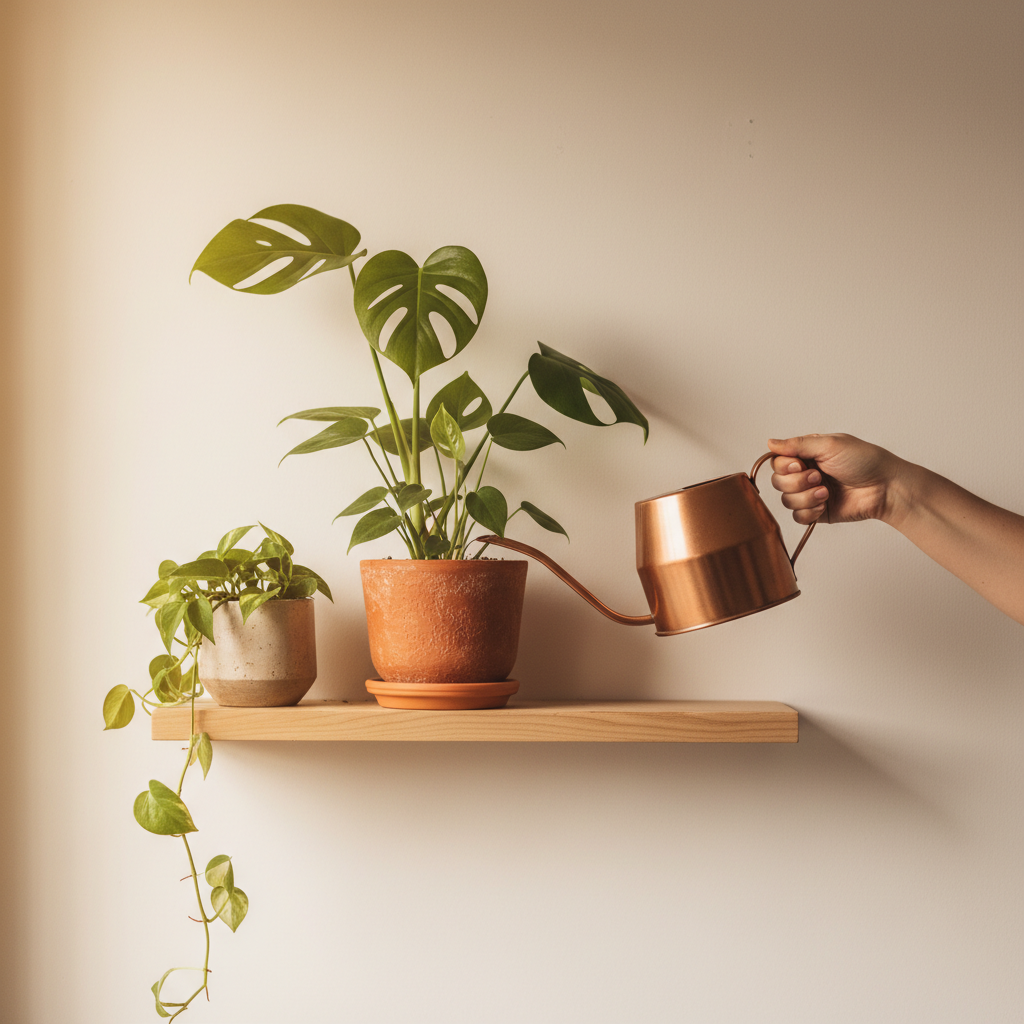
I weighed three Monstera pots over 14 days, and the pattern was boring in the best way: the one in a terracotta pot dried fastest, the plastic pot stayed wet longest, and the chunky bark mix landed in the middle. At the shop, that’s exactly what I see when someone brings in a droopy Monstera with yellowing lower leaves. The plant usually isn’t “thirsty” in the internet sense. It’s sitting in soil that stayed wet too long.
Key Takeaway
For monstera watering, judge the soil and the pot, not the calendar. The right timing changes with light, temperature, pot material, and mix.
Why does my Monstera stay wet for so long?
At least once a week someone brings in a Monstera deliciosa or Monstera adansonii and says, “I watered it five days ago and it still feels damp.” Usually the plant is in a pot that’s too large, a mix that holds too much peat, or both. Most guides say monsteras like moisture, and that’s true. I disagree with the way people hear that phrase. “Moist” does not mean soggy for a week.
In my shop, the biggest difference comes down to air around the roots. A 6-inch terracotta pot can dry in 4-6 days in a 72°F room, while a similar plastic pot may hang onto moisture for 8-12 days. Add a north-facing window, and the soil can stay wet even longer. Spider Farmer and The Sill both point readers toward letting the top layer dry before watering again, which matches what I see in real homes.
Side note: decorative cachepots are sneaky. A nursery pot sitting inside a ceramic cover can trap runoff, so the bottom of the root ball stays wet even when the top looks fine.
What I check before I water
I use three cues: pot weight, finger test, and leaf posture. If the pot feels heavy and the top 2 inches are still cool, I wait. If the mix feels light and crumbly down to about 2 inches, I water thoroughly. If the leaves are curling downward but the soil is still damp, that’s not a watering problem; that’s often a root problem.
For Monstera ‘Thai Constellation’, I’m even more cautious. Variegated plants grow slower, so they drink less. They punish overwatering faster than a plain green deliciosa.
How often should you water in a real home?
There isn’t one perfect monstera watering schedule, because a plant in a sunny east-facing window behaves differently from one under a lamp in a cool apartment. In general, I see healthy plants needing water about once a week in summer, and more like every 10-14 days in winter. That’s not a rule. It’s a starting point.
Here’s the range I actually trust:
| Condition | Typical watering rhythm | Notes |
|---|---|---|
| 65-75°F (18-24°C), filtered light | 7-10 days | Common for a healthy Monstera deliciosa in active growth |
| Cool room around 60-65°F (16-18°C) | 10-14 days | Soil dries slowly; watch for stale, heavy mix |
| Near an east window, summer | 5-8 days | More light means faster use of water |
Humidity matters, but not the way social media says. A room at 40% humidity can still support a happy monstera if the roots get oxygen. I’d rather see slightly drier air and a well-draining mix than a swampy pot with a humidifier blasting all day.
Your mileage may vary if your home runs dry in winter or your plant sits in USDA zone 9 conditions on a shaded patio. Outdoor plants dry faster in wind and heat, sometimes in 2-4 days.
What soil and pot setup makes watering easier?
This is where most people accidentally fight their plant. A chunky mix drains faster, which makes monstera watering less risky. I like a blend that feels airy in the hand: potting mix, orchid bark, and perlite. If the mix looks like mud after watering, it’s too dense for long-term success.
Pot material matters more than people admit. Terracotta pulls moisture from the sides, so it helps if you tend to overwater. Plastic holds water longer, which can be useful in a very dry, sunny room but is a bad match for a heavy hand. Ceramic is fine if it has drainage and you empty the saucer after watering.
At the shop, the classic mistake is a big pot for a small root ball. A plant in an 8-inch pot with roots that barely fill 5 inches of space will stay wet too long. I tried that setup first with one of my own plants, and it didn’t work. The soil stayed cold and damp for days, even though the leaves looked fine at first.
How much water should go in?
Don’t sip-water a monstera. Water enough to soak the root ball, then let excess drain out. For a 6-inch pot, that might be around 500-700 ml, depending on the mix. For an 8-inch pot, it can be closer to 900-1200 ml. The exact amount changes with dryness, but the goal is always the same: fully wet the roots, not the saucer.
If water runs straight through in seconds, the mix may be hydrophobic and need a slower second pass. If it puddles on top for more than 20-30 seconds, the soil is probably too compact.
What do yellow leaves and drooping actually mean?
Yellow lower leaves are the complaint I hear most. People assume the plant wants more water, so they water again. That usually makes things worse. One or two aging leaves can be normal, but if several leaves turn yellow and the stems feel soft, I start thinking root stress, not thirst.
Drooping is trickier. A thirsty monstera will often perk up within a few hours after a deep watering. A plant with overwatered roots won’t bounce back that fast. Its leaves may stay limp, and the soil may smell sour. That’s the point where I’d unpot it, check the roots, and trim anything mushy.
Most guides treat yellowing like a single symptom. I don’t. I look at the whole setup: pot size, light, room temperature, and how long the soil has stayed wet. In a 68°F room with low light, a Monstera adansonii can sit wet for over a week and still look “okay” until it suddenly doesn’t.
What’s the simplest monstera watering routine to follow?
Here’s the routine I’d give a customer standing at the counter with a plant in one hand and a soggy saucer in the other: check the pot weight, press a finger 2 inches into the mix, and water only when both say “dry enough.” If you want a schedule, use it as a reminder to inspect, not as an automatic pour.
- Water deeply, then empty the saucer.
- Use a pot with drainage every time.
- Choose a chunky mix over straight indoor potting soil.
- Expect faster drying in brighter spots and slower drying in cool rooms.
One more practical note: if your Monstera lives by a north-facing window, it will usually need less water than one near an east window with a few hours of morning sun. That’s not plant drama. That’s physics.
What should you do when you’re still unsure?
If the plant looks healthy, the pot feels lighter, and the top couple of inches are dry, water it. If you’re unsure and the soil still feels cool, wait a day. Monsteras tolerate a missed watering better than a soaked root ball, and that’s the part people forget.
Q: Can I water my Monstera on a fixed weekly schedule?
A: You can use weekly as a reminder, but not as a rule. In a dry, bright room, weekly may be right. In a cool space with low light, it can be too much.
Q: Should I mist instead of watering?
A: No. Misting doesn’t water the roots, and roots are the whole story here. It may make the leaves look nice for a minute, but it won’t fix dry soil or help a thirsty plant.
Q: Is brown leaf tip always a watering problem?
A: Not always. It can come from mineral buildup, low humidity, or inconsistent watering. I’d check the soil first, then the pot and water quality.
Monstera watering gets easier when you stop chasing a calendar and start reading the pot. If the roots have air, drainage, and a mix that dries at a sensible pace, the plant usually does the rest.
Related reading
Sources: spiderfarmer.eu, livelyroot.com, houseplantresourcecenter.com, thesill.com, epicgardening.com