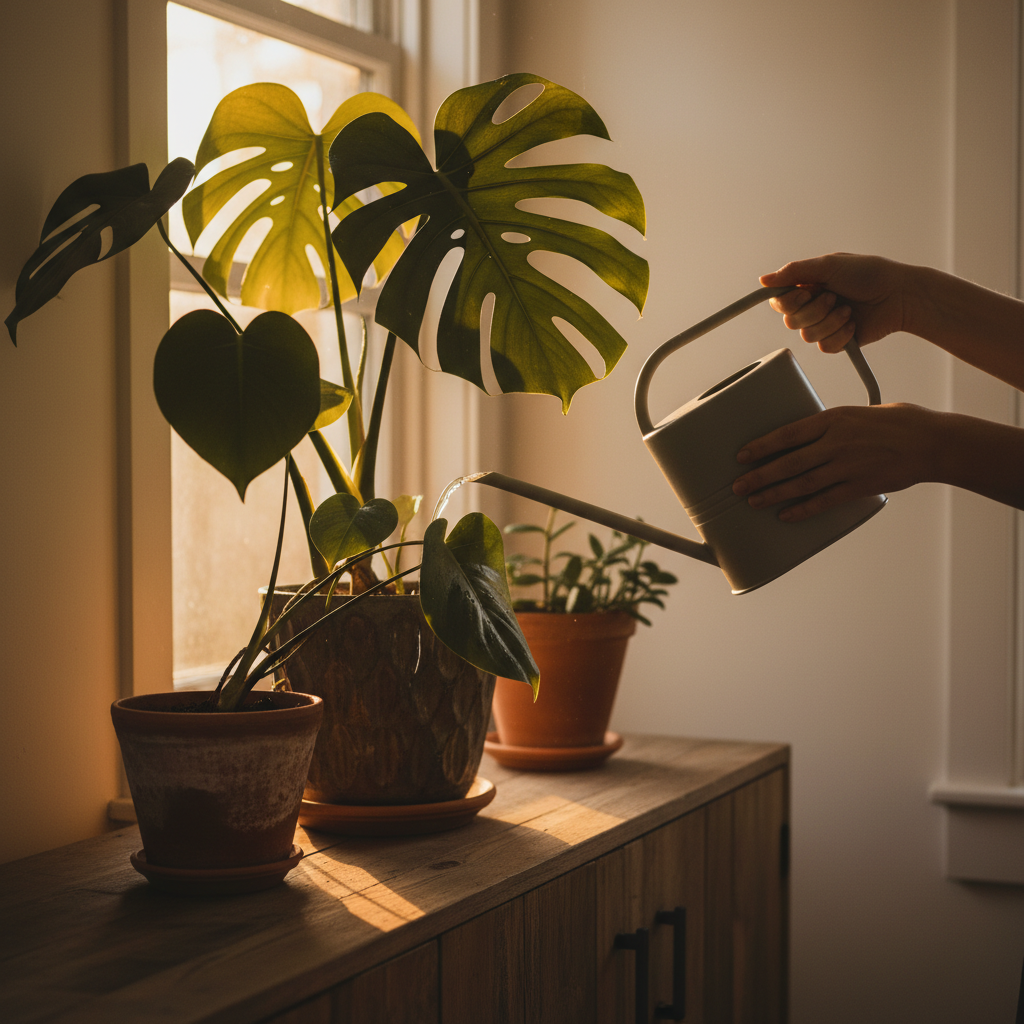
Stop using a moisture meter as the final word on monstera watering. I see too many customers trust the number, soak the pot, and then wonder why the lower leaves turn yellow 10 days later. The plant usually wanted a better potting mix, not more gadgets.
1. Read the pot, not the gadget
At least once a week someone brings in a Monstera deliciosa with a meter reading “dry” while the root ball is still damp 2 inches down. That’s why I push people to look at the pot itself first. A nursery pot that feels light, soil that pulls away from the edge, and a top layer that’s dry for 3-5 days are better clues than one more screen telling you what to do.
Most guides say to water on a strict schedule. I disagree because homes aren’t identical. A plant in a north-facing window in January behaves nothing like one in a south window at 78°F (25.5°C). Your job is to notice the pattern in your room, not obey a calendar.
Side note: decorative cachepots make this harder. I’ve pulled out plenty of Monsteras from ceramic covers with 150 ml of stale water sitting at the bottom. That’s not “extra humidity.” That’s a root problem waiting to happen.
What the plant is actually telling you
If the leaves look firm and the pot still has some heft, wait. If the mix is dry down to the first knuckle and the pot feels suspiciously light, water deeply. In my experience, a healthy Monstera will forgive a day or two of dryness far more easily than soggy roots for 48 hours.
2. Water by weight and soil feel
The best monstera watering habit is boring: lift the pot, feel the mix, then water. A 10-inch pot with a peat-heavy blend can hold a lot more moisture than a 6-inch nursery pot, so the same “every 7 days” rule falls apart fast. I’d rather see someone check every 4 days and water only when needed than drown the plant on autopilot.
Here’s the practical version. If the top 2 inches are dry and the pot feels about 30-40% lighter than after watering, go ahead. Pour slowly until water runs out the drainage holes, then stop. For a medium Monstera in a nursery pot, that may mean roughly 400-700 ml, but the exact amount depends on pot size and mix.
People also overthink leaf droop. A slightly relaxed leaf at 5 p.m. doesn’t always mean thirst. If the plant perks up by morning, leave it alone. If the petioles stay limp for 2-3 days and the soil is bone dry, then yes, it’s time.
Why “just add ice cubes” is nonsense
You’ll see this advice everywhere — it’s wrong because tropical aroids don’t want cold shock. Ice can chill roots below 60°F (15.5°C), and that’s not a cute trick; it’s stress. Room-temperature water around 65-75°F (18-24°C) is the safer move.
3. Match watering to light, pot size, and season
Light changes everything. A Monstera under filtered light through a sheer curtain near an east-facing window may dry in 6-9 days. The same plant in a dim corner might stay damp for 10-14 days. That’s why watering advice gets messy online: people copy a number without copying the room.
I keep telling customers this because it comes up constantly. The plant on a sunny shelf in July drinks faster than the one 2 meters back from the glass in December. In a 68°F (20°C) room with average indoor humidity around 40%, you’ll usually water less often than in a 76°F (24.5°C) room with a fan moving air.
Pot material matters too. Terracotta can pull moisture away faster, especially in USDA zone 9 homes where indoor air stays drier in winter. Plastic holds water longer, which is helpful if you’re forgetful, but dangerous if your mix is dense.
Key Takeaway
Monstera watering is mostly a response to light, pot size, and mix. The calendar is the least useful tool in the room.
4. Fix the mix before you fix the schedule
If your Monstera keeps getting yellow leaves after watering, the schedule may not be the real problem. The mix might be too dense. A chunky blend with bark, perlite, and a moisture-retentive base drains better than plain houseplant soil packed into a heavy ceramic pot. That matters more than whether you water on day 7 or day 9.
I’ve repotted thousands of these, and the pattern is obvious. A plant in a tight peat plug can stay wet for 12 days after a thorough soak, while the same plant in an airy aroid mix may need water again in 5-8 days. That’s not inconsistency. That’s physics.
I tried telling people to “water less” for years, and it didn’t solve much. Repotting into a better mix did. If the roots are circling the pot or the mix smells sour after 24 hours, the plant needs a different home, not just a gentler hand with the watering can.
| Setup | Typical drying pace | Watering style |
|---|---|---|
| Chunky aroid mix in plastic pot | 5-8 days | Deep soak, then let it dry partway |
| Dense peat-heavy mix | 10-14 days | Water sparingly, repot soon |
| Terracotta on a sunny sill | 4-7 days | Check weight often |
| Large pot in low light | 12+ days | Wait longer between waterings |
5. Know the warning signs before they spread
Yellowing from the bottom up usually points to overwatering, especially if the soil stays wet for more than 72 hours. Brown, crispy edges can mean underwatering, but they can also mean mineral buildup if you’ve been using hard tap water. Don’t guess from one leaf.
Look at the whole plant. If new leaves are smaller than usual, the roots may be struggling. If the stem near the soil line feels soft, stop watering and check for rot. If the plant is dropping leaves after a cold snap below 60°F (15.5°C), the issue may be temperature stress instead of moisture.
At the shop, a Monstera ‘Thai Constellation’ is the one that makes people nervous fastest because it looks expensive and dramatic. It still wants the same logic: evenly moist, never swampy. Variegated plants can’t photosynthesize as hard, so they often need a bit less water than a fully green Monstera of the same size.
A quick reality check
If you’re not sure whether the plant wants water, wait 24 hours and check again. That one pause saves more Monsteras than most “care hacks.”
6. Use the right amount of water, then drain it
The goal isn’t to sprinkle the surface. It’s to wet the entire root zone, then let excess drain away. For a 6-inch pot, that might be 250-350 ml. For a 10-inch pot, it can be 600-900 ml. The exact number matters less than the result: evenly moist soil, no standing water.
I like to water in two passes. Give the pot a first pour, wait 30 seconds, then add more until you see runoff. That helps dry pockets absorb water instead of letting it race around the edges. If you’re using a heavy mix, this step matters even more.
Never leave a Monstera sitting in a saucer for more than 15 minutes. Drain it, empty the tray, and move on. That simple habit prevents a lot of root rot, especially in winter when evaporation slows down.
7. Special cases: young plants, big plants, and variegated ones
Small Monsteras dry faster because the root mass is smaller. A young plant in a 4-inch pot may need water after 4-6 days in a 72°F (22°C) room, while a mature plant in a 12-inch pot can go 8-12 days. Bigger doesn’t mean thirstier. It often means slower.
Newly repotted plants are tricky for the first 2-3 weeks. The roots need time to settle, so I keep the mix slightly less wet than usual and avoid soaking it twice in a row. If the plant was just moved from a soggy peat plug into a chunky mix, it may still need a longer pause before the next watering.
Variegated Monsteras, especially ‘Thai Constellation,’ can burn through water differently because of their reduced green tissue. But don’t overcorrect. More water won’t create more variegation; it usually just creates messier roots.
8. The simple routine that actually sticks
Here’s the routine I’d give a customer who wants fewer mistakes: check the pot every 3-4 days, water only when the top layer is dry and the pot feels light, and use a mix that drains well enough to dry partway within a week or so. That’s it. No ritual, no drama.
If your home runs at 40-50% humidity, keep the plant away from heating vents and blasting AC. If the room sits around 65-75°F (18-24°C), you’re in a comfortable zone for steady growth. If it drops below 60°F (15.5°C) at night, slow down the watering and let the soil stay drier.
One more thing: consistency matters more than perfection. A Monstera can handle a slightly late watering. It handles wet roots much worse.
| Situation | What to do | Typical timing |
|---|---|---|
| Dry top layer, light pot | Water thoroughly | Same day |
| Cool room, damp mix | Wait and recheck | 24-48 hours |
| Yellow leaves plus wet soil | Pause watering and inspect roots | Immediately |
| Chunky mix drying fast | Adjust frequency upward | Every 5-8 days |
Q: Should I bottom-water my Monstera?
A: You can, but I wouldn’t make it the default. Bottom-watering is fine for a very dry mix, yet it can leave the top layer dry while the middle stays soggy. For most homes, a slow top-water with full drainage is simpler and more reliable.
Q: How do I know if I’m underwatering or overwatering?
A: Underwatering usually gives you dry, crispy edges and a pot that feels feather-light. Overwatering tends to bring yellowing leaves, soft stems, and soil that stays wet for 5+ days. The roots tell the truth faster than the leaves do.
Q: Does a Monstera need more water in winter?
A: Usually less. Shorter days, lower light, and cooler indoor air slow growth. In many homes, watering stretches from weekly to every 10-14 days, especially if the plant sits farther from the window.
Bottom line: Water your Monstera by soil dryness, pot weight, and room conditions, not by a rigid calendar.
Related reading
Sources: spiderfarmer.eu, soltech.com, thesill.com, livelyroot.com