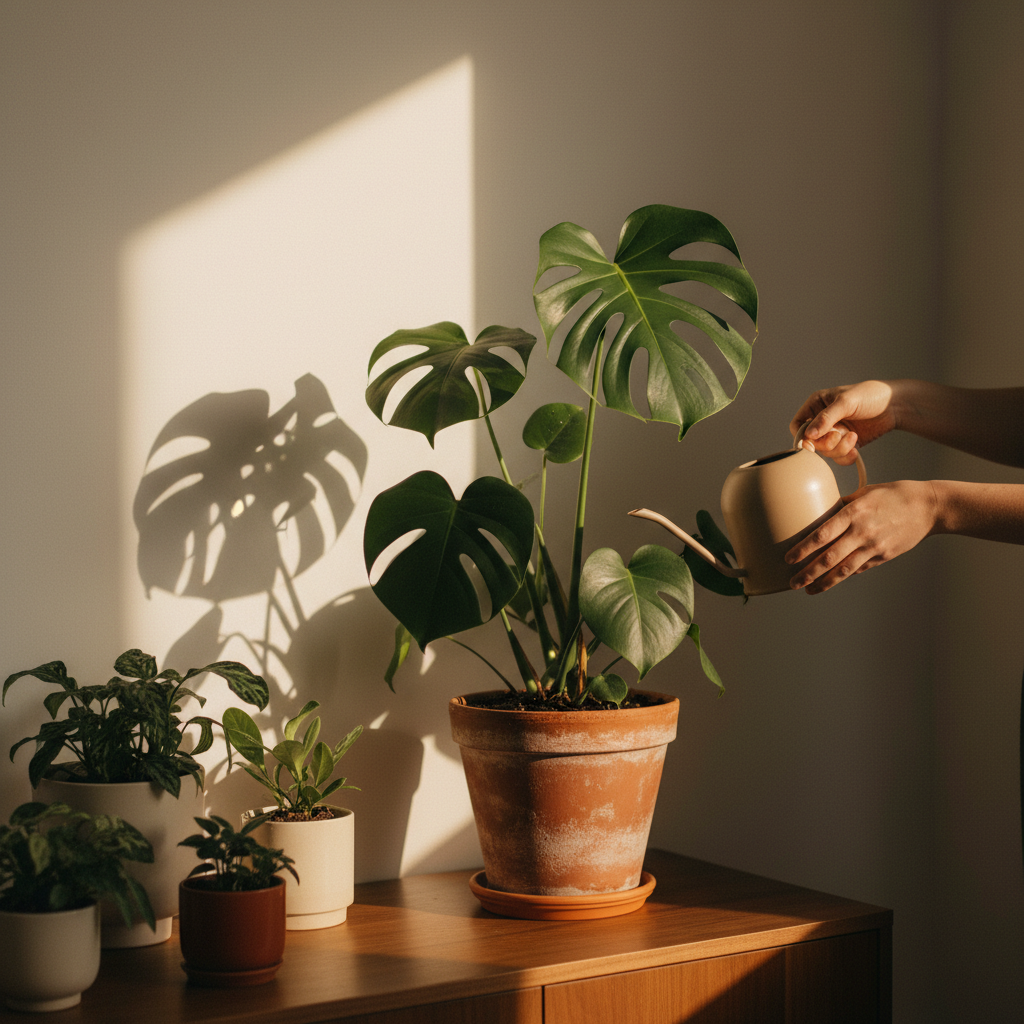
I weighed three Monstera pots over 14 days in the shop, and the one in a terracotta pot lost moisture fastest by far. The plastic-pot plant stayed heavier longer, even in the same room at about 70°F (21°C). That’s the whole game with monstera watering: the calendar is less useful than the pot, the mix, and how much light the plant actually gets.
Why does one Monstera dry out in 4 days while another still feels heavy after 10?
Because the roots aren’t living in the same setup, even if the plants look similar. At least once a week someone brings in a Monstera deliciosa that “should” have been watered on Sunday, but it’s in a chunky, bark-heavy mix in a clay pot by an east-facing window. Of course it’s dry. Another customer has the same plant in a deep nursery pot, tucked farther from the glass, and it’s still damp a week later.
Pot material matters more than people think. Terracotta pulls moisture out faster, while plastic and glazed ceramic hold it in. Soil mix matters too: a chunky blend with orchid bark and perlite drains fast, while a peat-heavy mix stays wet longer. If you’re using a pot with no drainage hole, that’s a separate problem entirely. I’d rather see a Monstera in a plain nursery pot inside a cachepot than in a pretty pot that traps water.
Light changes the pace. Near a north-facing window, a Monstera may need water every 10-14 days. In stronger filtered light, it might want it closer to every 6-8 days. Most guides say to water on a strict schedule. I disagree because the plant doesn’t care what day it is. It cares whether the root zone is drying at a healthy pace.
How do you know it’s time to water without guessing?
Use your fingers, a chopstick, or a moisture meter if you trust it. I still like the old-fashioned check: push down 2 inches, about 5 cm, and see if the mix is dry or just barely cool. If it’s dry at that depth and the pot feels light, that’s your cue. If it’s still heavy, wait.
There’s a difference between “surface dry” and actually ready. The top layer can look dusty while the lower root ball is still damp. That’s why people overwater Monstera adansonii and Monstera deliciosa alike. The leaves start yellowing, then the stems get soft, and suddenly you’re dealing with rot instead of thirst.
Side note: a lot of “droopy Monstera” cases are not underwatering at all. They’re either too wet, too cold, or sitting in a pot that’s much larger than the root mass. If the plant was repotted recently, give it a few days before you assume it needs another drink.
Key Takeaway
Water when the root zone is partly dry, not when the week says so. For most indoor Monstera plants, that means checking the pot every 5-7 days and watering only when the lower mix has started to dry.
What kind of room changes monstera watering the fastest?
Room conditions can swing monstera watering more than people expect. A plant near a south-facing window in summer may dry out in 4-6 days. The same plant in a cooler room around 65°F (18°C) and 50% humidity might hold moisture for 10 days or more. If your home runs dry in winter, the plant can still need less frequent watering because growth slows down.
I pay attention to three things: temperature, humidity, and airflow. Monstera generally likes indoor temps around 65-85°F (18-29°C), but it won’t drink at the same pace across that whole range. Humidity around 40-60% is fine for many homes, though lower humidity usually means the top layer dries faster. A ceiling fan or vent can also change the timing by a couple of days.
For Monstera ‘Thai Constellation’, I’d be especially cautious. The variegated leaves don’t mean the plant needs more water; if anything, the slower growth often means it uses water more slowly. That’s one of those internet myths I push back on hard. Variegation changes light needs more than thirst.
How much water should you actually give the pot?
Water deeply, then let the pot drain completely. For a 6-inch pot, that might be around 250-400 ml depending on the mix; for an 8-inch pot, it can be closer to 500-700 ml. The exact amount matters less than making sure the whole root zone is moistened and excess water exits the drainage hole.
Don’t do the “half-cup every few days” routine. That keeps the top moist and the bottom dry, which is a weird setup for roots. I prefer a full soak until water runs out underneath, then I empty the saucer. If the pot is in a decorative outer cover, never leave it sitting in runoff.
Here’s the practical split I use in the shop:
| Setup | Typical watering pace | Notes |
|---|---|---|
| Terracotta, chunky mix | About every 5-8 days | Dries fastest, especially near windows |
| Plastic nursery pot, airy mix | About every 7-12 days | Often the easiest for beginners |
| Large ceramic pot, dense mix | 10-14 days or longer | Watch closely for soggy roots |
What mistakes keep showing up on the bench?
The biggest one is watering a Monstera before the lower half of the pot has dried. The second is using a pot that’s too large. A plant in a 10-inch pot with a small root system will stay wet far longer than it should, and that’s how rot sneaks in. I’ve also seen people use heavy garden soil indoors. That’s not plant care; that’s a slow swamp.
Another mistake is chasing a single yellow leaf with more water. One old leaf yellowing every so often is normal. Several yellow leaves plus mushy stems and a sour smell? That’s overwatering territory. If the plant is thirsty, you’ll usually see a softer droop and a lighter pot, not a collapsing stem.
In my experience, the best fix is boring and effective: smaller pot, drainage hole, airy mix, and slower watering. You don’t need a fancy system. You need consistency and a little restraint. I tried bottom-watering every time for one customer’s Monstera and it didn’t solve the soggy center, because the mix itself was too dense.
Q: Should I mist my Monstera instead of watering it?
A: No. Misting doesn’t replace monstera watering, and it barely changes the long-term humidity around the plant. If the air is dry, use a pebble tray, a humidifier, or simply accept that the plant will dry a bit faster.
Q: Can I water on a fixed schedule?
A: You can use a schedule as a reminder, but not as the final decision. A weekly check is useful; a fixed weekly pour is not. Your plant in a north-facing window will behave differently from one under stronger indoor light.
Q: What’s the fastest way to tell if I overwatered?
A: Heavy pot, wet mix, and limp leaves are the usual trio. If the pot still feels heavy after several days and the soil smells sour, stop watering and let it dry out before doing anything else.
Bottom line: water your Monstera when the pot says it’s ready, not when the calendar does. What does your plant’s pot feel like today?
Related reading
Sources: soltech.com, livelyroot.com, houseplantresourcecenter.com, plantelio.com