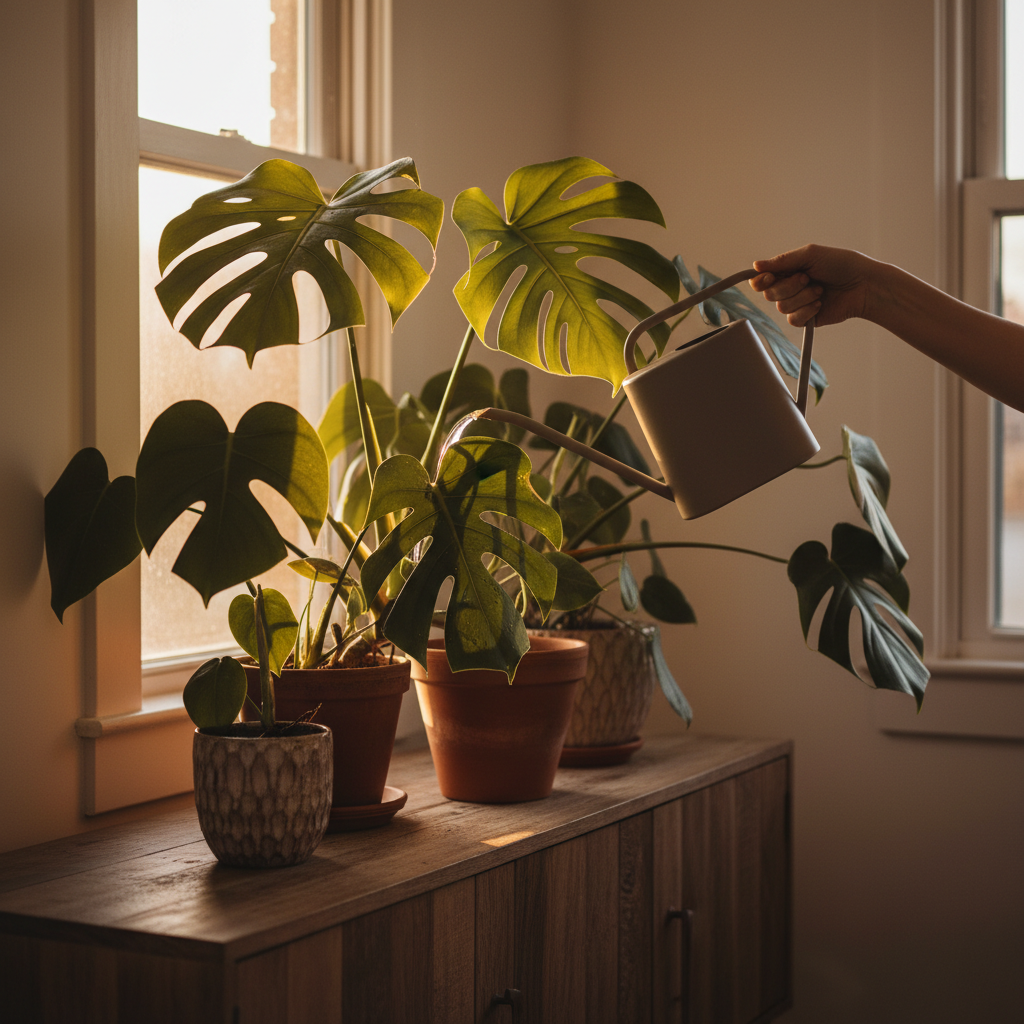
Stop using a moisture meter as your only guide for monstera watering. A cheap probe can read “wet” in one spot and “dry” in another, and that mismatch is how people end up with limp leaves, sour-smelling soil, and roots that never get a real chance to breathe.
1. Read the soil, not the calendar
The most useful monstera watering habit is also the least glamorous: stick a finger into the mix and trust what you feel. If the top 2 inches are dry but the layer below is still cool, I wait. If the upper half of the pot is dry and the pot feels noticeably lighter, that’s usually my cue.
Most guides flatten this into a neat schedule, but Monstera deliciosa doesn’t care about your reminders app. In my experience, a plant near an east-facing window in USDA zone 9 conditions may need water faster than one sitting 6 feet from a south window with sheer curtains. Same species, different thirst.
Penn State Extension has long emphasized that overwatering is more about oxygen loss in the root zone than about “too much water” in a vague sense. That tracks with what I see: a pot can stay wet for 8-12 days and still be a problem even if the leaves look fine on day 3. Side note: a plant can be thirsty and still have wet soil if the roots are damaged. That’s where people get fooled.
One small caveat the typical guide ignores: the surface can dry fast while the lower half stays soggy, especially in a dense peat-heavy mix. So don’t water just because the top crust looks dusty. Check deeper.
2. Match water to light and temperature
Light and temperature drive how fast a monstera drinks. A plant in filtered light at around 68-75°F (20-24°C) will usually use water more slowly than one getting 2 hours of gentle morning sun and sitting near 78°F (26°C). That difference can mean watering every 7-10 days versus stretching to 12-14 days.
Bloomscape notes that monsteras prefer bright, indirect light, and that lines up with my own observation: the more direct sun a leaf gets, the faster the pot dries. I’ve had Monstera deliciosa stay stable for nearly 2 weeks in a cooler room around 65°F (18°C), while a Monstera adansonii in a brighter spot wanted water sooner. Your mileage may vary, which is why the calendar alone is overrated.
Humidity matters too. Around 40% humidity, soil and leaves can lose moisture faster than in a room hovering near 60%. That doesn’t mean you should “compensate” by soaking the pot. It means you may need to check more often and water a bit sooner, not more aggressively.
Here’s the part people skip: the same plant can shift its rhythm across seasons. In winter, when my office sits around 66-70°F (19-21°C), a monstera may go 10-15 days between waterings. In summer, with the thermostat nudging 72-76°F (22-24°C), it can ask sooner. The plant is not being dramatic. It’s responding to physics.
3. The pot, drainage, and mix that change everything
A 6-inch terracotta pot and a 10-inch plastic nursery pot do not behave the same, even if the plant is the same size. Terracotta wicks moisture, so the mix may dry 1-3 days sooner. Plastic holds water longer, which is useful if your room runs dry, but risky if you already tend to overwater.
Drainage holes matter more than decorative cachepots. A monstera in a pot without drainage can look fine for a week and then decline fast because water pools at the bottom. Spider Farmer notes that monstera roots want a well-aerated mix, and that matches the extension-style advice I trust most: airy soil beats “more water” every time.
I like a mix that drains quickly but still holds enough moisture to avoid constant babysitting. Think chunky bark, perlite, and a potting base that doesn’t collapse into mud after one watering. If the mix stays compacted for 30 days, it’s too heavy. If it dries in under 24 hours in average indoor conditions, it may be too airy unless your home is very dry.
Personal note: after 14 months with one Monstera ‘Thai Constellation’, I found it tolerated a slightly airier mix than my plain deliciosa, but it still hated sitting in a saucer of runoff. I haven’t figured out why some growers get away with that longer than others. Maybe pot size, maybe root mass, maybe luck.
4. How much water to give, and what that looks like in practice
“Water thoroughly” sounds vague until you define it. For a medium monstera in a 6- to 8-inch pot, I usually pour until I see steady runoff from the drainage holes, then stop. That often looks like roughly 300-600 ml for a smaller plant and more for a root-bound larger one, though pot size and mix matter more than a fixed number.
What you want is even wetting, not a splash that only moistens the top 1 inch. If the water races through in seconds, the mix may be hydrophobic or too chunky. If it sits on top for longer than 20-30 seconds, pour more slowly and in two passes so the root ball actually absorbs it.
A practical rule: after watering, the pot should feel heavier and the top layer should be evenly damp, not muddy. By the next day, the surface should be starting to dry, not staying glossy. If it’s still dark and cool after 4 days in a 70-72°F (21-22°C) room, I’d suspect too much water or too little airflow.
Bloomscape’s guidance on letting the top layer dry before watering again is the one I’d keep. I disagree with the common “just water on Sundays” approach because it ignores plant size, pot material, and season. A Monstera adansonii in a small pot will not follow the same rhythm as a mature deliciosa in a heavy ceramic planter. That’s just reality.
5. Fixing overwatering before the roots quit
Yellow leaves are not always thirst. If the soil smells sour, stays wet for more than 10 days, or the stem base feels soft, think root stress first. A plant can shed a leaf after 3-5 days of bad conditions and still look “almost okay” to the casual eye.
The first move is boring but effective: stop watering and let the mix dry to a safe level. If the pot is oversized, moving the plant into a smaller container can help because less soil means less water hanging around for too long. I’ve had better luck saving a stressed monstera by trimming damaged roots and repotting into a better-draining mix than by trying to nurse it in the same soggy pot.
One detail that gets ignored: cold rooms slow drying dramatically. At 60-65°F (16-18°C), a pot that would dry in 7 days at 72°F (22°C) may take far longer. That’s why overwatering problems spike in winter, especially near a cool window or on a floor that pulls heat away from the pot.
If you’re unsure, wait another 24-48 hours before watering. That pause is often enough to avoid turning a mild mistake into a root-loss problem. It’s not glamorous, but neither is potting up a mushy plant and hoping for the best.
6. A simple comparison table for different monstera setups
Different homes call for different monstera watering rhythms. This table is a practical starting point, not a law. Use it as a range, then adjust based on pot weight, soil feel, and room conditions.
| Setup | Typical drying time | Watering rhythm | Notes |
|---|---|---|---|
| Small pot, terracotta, east-facing window | 5-8 days | About once a week | Dries faster; check after 4 days |
| Medium plastic pot, filtered light | 7-12 days | Weekly to every 10 days | Watch for cool, damp soil below the surface |
| Large ceramic pot, lower light | 10-15 days | Every 10-14 days | Higher risk of soggy roots if watered on a fixed schedule |
| Monstera adansonii in a small airy mix | 4-7 days | Twice monthly or sooner in summer | Usually faster-draining than Monstera deliciosa |
Key Takeaway
Water when the soil has dried enough to need it, not when the calendar says so. For most indoor monsteras, that means a thorough soak, then a pause until the upper half of the pot has clearly dried.
7. FAQ on monstera watering
Q: Should I mist my monstera instead of watering the soil?
A: No. Misting can raise humidity for a few minutes, but it doesn’t hydrate the roots. If your room is around 35-45% humidity, misting won’t replace a proper watering. Soil moisture is what matters for monstera watering.
Q: Is bottom watering okay for Monstera deliciosa?
A: Yes, if you let the pot absorb water for 15-20 minutes and then drain it fully. I use it occasionally for a dry, compacted mix, but I still prefer top watering because it flushes salts better. Bottom watering alone can leave the top layer dry while the lower roots stay too wet.
Q: How do I know if I’m underwatering?
A: Leaves may droop, curl slightly, or feel less firm, and the pot will feel very light. If the soil pulls away from the sides of the pot and the plant perks up within 12-24 hours after watering, underwatering was probably the issue. If it doesn’t perk up, check roots and drainage.
8. Bottom line for healthier leaves
Monstera watering works best when you respond to the plant’s actual conditions: light, temperature, pot size, and soil texture. If you want one habit that pays off fast, make it this: check the soil with your finger, then water deeply only when the pot has truly dried enough.
That simple shift prevents more yellow leaves than any fancy gadget I’ve tried. What’s your setup like?
Related reading
Sources: abeautifulmess.com, bloomscape.com, spiderfarmer.eu