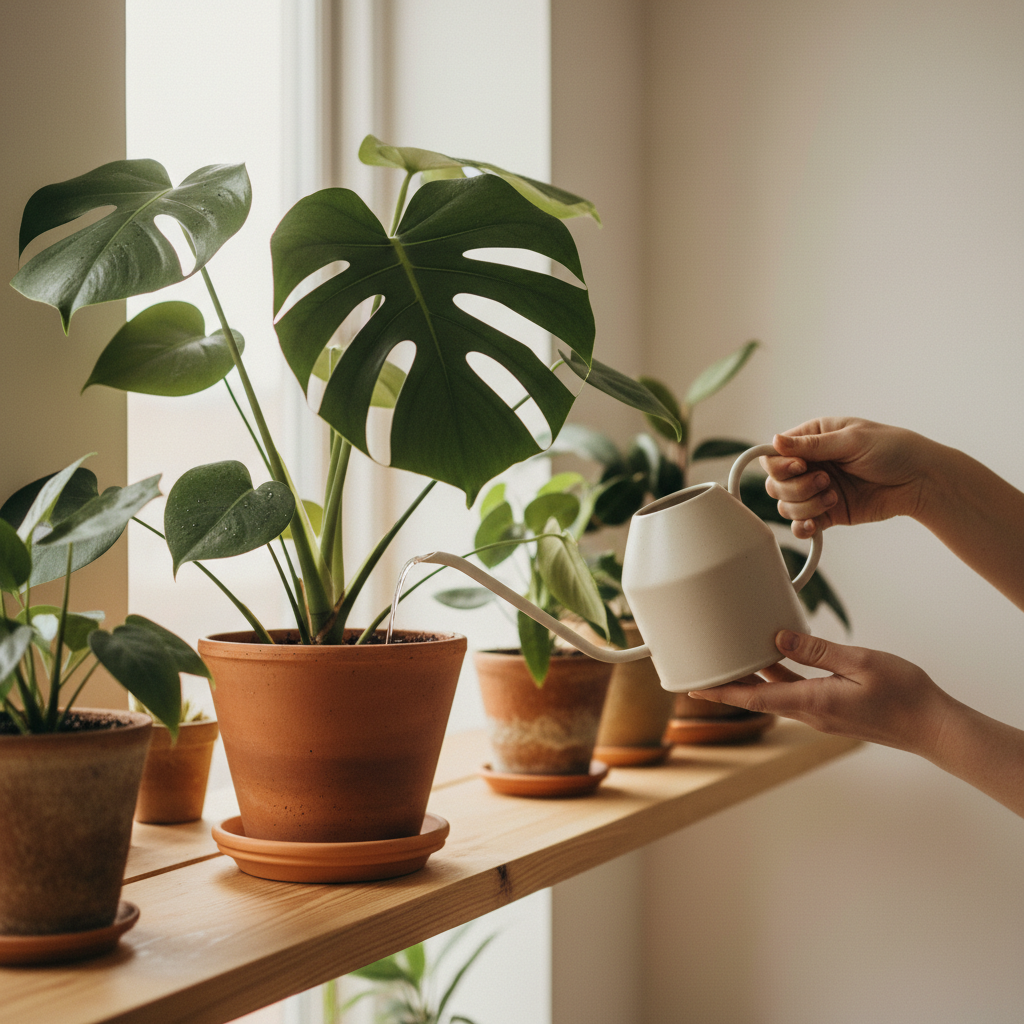
It’s 3pm in February, the heat is blasting, and the Monstera leaves are drooping again. I’ve been there, staring at a pot like it owes me money. The annoying part is that droop can mean thirst, rot, or just a plant being dramatic, and guessing wrong is how I rotted three philodendrons before I figured this out…
Key Takeaway
Monstera watering works best when you treat the soil like the source of truth, not the calendar.
1. Read the soil, not the calendar
The fastest way to stop overwatering a Monstera deliciosa is to ignore the “every Saturday” advice. Honestly, that schedule is how people end up with mushy roots and sad yellow leaves. I’m not convinced plants care what day it is.
Stick your finger 2 inches down, or use a wooden skewer if you hate dirt under your nails. If it comes out cool and damp, wait. If it’s dry most of the way down, water. In a typical home around 68-75°F (20-24°C), that might be every 7-10 days, but in a cooler room near 60°F (16°C), it can stretch closer to 12-14 days.
For a smaller plant in a 6-inch pot, I usually think in terms of volume, not vibes: about 300-500 ml at a time, then pause. A bigger Monstera in a 10-inch pot may take closer to 700-1000 ml, depending on drainage and light. Side note: a pot that holds water like a bucket is not a pot, it’s a swamp with delusions.
2. Give it a deep drink, then let it breathe
Most guides say to water “a little and often.” This might be controversial but I disagree. A thorough soak followed by a real dry-down usually works better for Monstera watering than tiny sips that only moisten the top layer. The roots want oxygen as much as they want water.
Water until you see runoff, then empty the saucer within 5-10 minutes. That’s the part people skip, and it matters more than fancy fertilizer. If your room sits around 50-60% humidity, the plant may dry more slowly than you expect, especially in winter when the heater is running.
For Monstera adansonii, I’m even more cautious than with a standard Monstera deliciosa. Smaller leaves, smaller root mass, faster mistakes. If the potting mix is chunky and airy, you can water a bit more generously; if it’s dense, back off. Your mileage may vary, but soggy mix is still soggy mix.
3. Match watering to light, season, and pot size
A Monstera near an east-facing window with 2-3 hours of gentle morning sun will usually drink faster than one parked across the room in medium indirect light. In summer, when indoor temps climb to 72-78°F (22-26°C), I often check mine every 5-7 days. In winter, when the room drops to 62-68°F (17-20°C), I might wait 10-14 days.
Pot size changes the whole game. A 4-inch nursery pot can dry fast, sometimes in 3-5 days, while a 12-inch decorative pot may stay damp for 2 weeks if the mix is heavy. That’s why Monstera ‘Thai Constellation’ tends to punish lazy watering more than people admit; it likes consistency, but it hates wet feet.
If you want one rule that beats most internet advice, here it is: water less often in low light, but don’t reduce the amount so much that only the top 1 inch gets wet. That just trains roots to stay shallow. I’d rather see a full soak every 8-12 days than a splash every 3 days.
4. What drooping, yellowing, and brown edges are actually saying
Droopy leaves can mean “I’m thirsty,” but if the soil is still wet 24 hours after watering, it’s more likely root stress than dehydration. Yellow lower leaves plus a heavy pot usually points to too much water. Crispy brown edges often show up when the plant is drying out too long, especially if humidity drops below 40%.
I check three things before I reach for the watering can: soil feel, pot weight, and leaf posture. A light pot with limp leaves is one story. A heavy pot with limp leaves is another. The second one is the one that gets people into trouble.
For a plant in USDA zone 9 on a shaded patio, the rhythm changes again. Outdoor heat and airflow can dry a pot in 1-3 days during a 90°F (32°C) spell. Indoors, the same plant may need twice as long. That’s why copying someone else’s schedule is usually a waste of time.
5. The watering setup that makes Monstera easier to keep alive
Good drainage matters more than almost anything else. A chunky mix with bark, perlite, and potting soil gives you a better margin for error than straight peat-heavy soil. If water sits on top for more than 10 seconds, the mix is probably too compact.
Here’s the comparison I wish I’d had when I started:
| Setup | Typical watering pace | Risk level | Best for |
|---|---|---|---|
| Chunky mix, drainage holes | About every 7-10 days | Lower | Most indoor Monsteras |
| Dense soil, decorative cachepot | Every 10-14 days or longer | Higher | Careful growers only |
| Small nursery pot, east-facing window | Every 5-8 days | Medium | Fast-drying rooms |
| Cool room, lower light, large pot | Every 12-16 days | Higher if overwatered | Patient people |
If you want the plant to forgive you, use a pot with drainage, keep the mix airy, and don’t water on autopilot. That’s the boring answer, but boring is good when the alternative is root rot.
6. FAQ: the stuff people keep asking after the first yellow leaf
Q: Should I mist my Monstera instead of watering it?
A: No. Misting doesn’t replace root watering, and it won’t fix a dry pot. It may bump surface humidity for a few minutes, but it’s not a real watering strategy.
Q: How do I know if I overwatered it?
A: If the soil stays wet for more than 3-4 days, the pot feels heavy, and lower leaves turn yellow, back off. Let it dry more fully before the next watering.
Q: Does a Monstera need more water in brighter light?
A: Usually yes. A plant near filtered light through a sheer curtain will dry faster than one in a dim corner. The difference can be several days, not just a few hours.
Bottom line: water Monstera deeply, then wait until the soil is actually ready again. What’s your plant telling you right now?
Related reading
Sources: soltech.com, abeautifulmess.com, livelyroot.com, spiderfarmer.eu