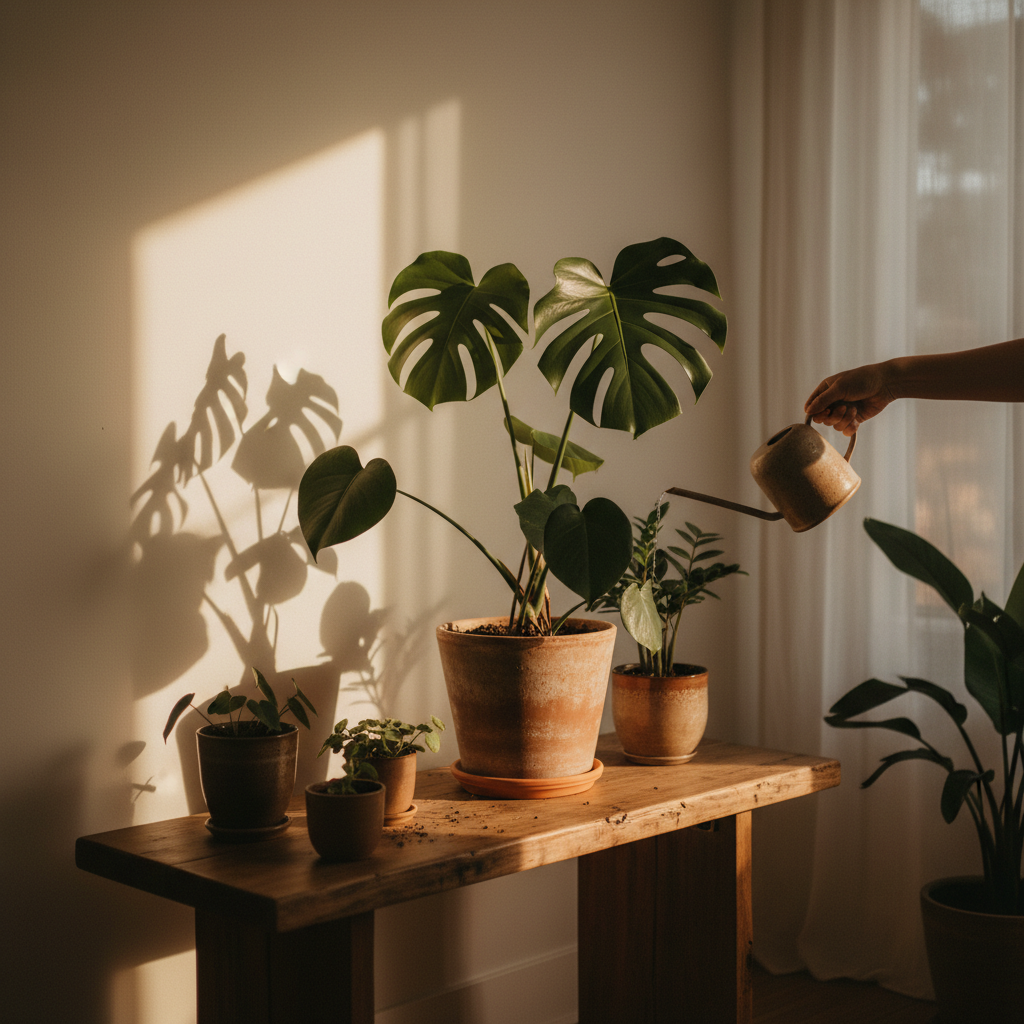
It’s 3pm in February, the Monstera leaves are drooping again, and the pot still feels heavy. That’s the trap: too many people water on a calendar, then act surprised when the roots turn mushy. I rotted three philodendrons before I figured this out, and honestly, Monstera deliciosa is not that much more forgiving.
1. Read the pot, not the calendar
Most guides act like monstera watering is a neat little schedule. I’m not convinced. A Monstera deliciosa in a north-facing window at 68°F (20°C) is playing a different game than one sitting under a grow light at 74°F (23°C).
My rule is simple: water when the top 2 inches feel dry and the pot has lost that heavy, damp feel. If you stick a finger in and the mix still clings cold to your skin, wait. If you have a moisture meter, aim for the dry-to-lightly-moist range, not “still swampy.”
This is the part people hate because it sounds vague. It isn’t, really. Soil dries in response to light, airflow, pot size, and the season. In a dry apartment, you might water every 7-10 days. In a cooler room during winter, it may stretch to 12-14 days.
Why the calendar fails
Calendars don’t notice cloudy weeks, heating vents, or that your plant got moved 3 feet away from the window. Your Monstera does. If the leaves are firm and the pot still feels hefty, don’t pour just because it’s “watering day.” That advice has killed more houseplants than underwatering ever did.
2. The soil mix that makes watering easier
Watering gets way less mysterious when the soil drains fast enough to behave. A chunky aroid mix is boring advice, but it’s boring for a reason. Standard potting soil can stay wet too long, especially in a plastic pot.
I like a mix that includes bark, perlite, and coco coir or peat, so water moves through instead of hanging around the roots. If you’re using a 10-inch pot, the center can stay wet for days after the top looks dry. That’s how people get tricked.
For a Monstera in active growth, the pot should drain freely within a few minutes after watering. If water sits on top for 30 seconds or more, the mix is probably too dense. Side note: this is where “more water” is not the fix. Better drainage is.
What I’d change first
If your plant is always wet, repot before you buy another watering gadget. A bag of perlite is cheaper than replacing a rotted Monstera. And yes, a terracotta pot can help because it dries faster, but it’s not magic. It just makes bad habits more obvious.
3. Light, temperature, and how fast water disappears
Monstera watering is really a light problem wearing a watering-can costume. Near an east-facing window with a couple of hours of direct morning sun, the plant drinks faster than it does in a dim corner. That’s just physics, not plant drama.
Most Monsteras are happiest around 65-80°F (18-27°C). Below 60°F (16°C), evaporation slows down and the roots stay wet longer. Above 80°F (27°C), especially with dry air, the soil can go from moist to bone dry faster than you expect.
Humidity matters too. Around 40-60% is plenty useful indoors, and it affects how quickly the pot dries. In a room hovering near 30% humidity, I’d check the soil more often. In a muggy bathroom with good light, I’d check less. Your mileage may vary.
One opinion that might annoy people
I think “mist the leaves” is overrated for watering decisions. It makes the plant look cared for, sure, but it does almost nothing for the roots. If the goal is healthier growth, spend your energy on light and drainage instead.
4. Pot size, drainage, and the ugly math of overwatering
A big pot with a small root ball is where monstera watering gets messy. The roots can only use so much moisture, and the extra soil stays wet. That’s especially true in pots larger than the root mass really needs.
Drainage holes are non-negotiable. I know some people use cachepots and decorative planters with no holes. This might be controversial but… I wouldn’t do that unless you’re very disciplined and willing to dump excess water every time. Most of us are not that disciplined.
If you water until liquid runs out the bottom, let it drain completely. Don’t let the pot sit in a saucer full of water for hours. Ten to 15 minutes is enough for drainage; after that, empty the tray. A plant in soggy runoff is basically wearing wet socks.
Key Takeaway
For Monstera watering, the pot, the mix, and the room matter more than a fixed schedule. Check soil depth, not the date on your phone.
5. What changes for Monstera ‘Thai Constellation’ and other fancy cultivars
Variegated plants like Monstera ‘Thai Constellation’ can be fussier because their lighter sections don’t photosynthesize as hard, so growth can be slower. Slower growth often means the plant uses water more slowly, which means overwatering becomes easier, not harder.
That doesn’t mean baby it with tiny sips every day. I’d still water deeply, then let the mix dry partway before watering again. The goal is even moisture, not constant moisture. A plant that’s always damp is a root-rot invitation, no matter how expensive the leaves look.
If you’re growing in USDA zone 9 outdoors for part of the year, watch for temperature swings. Once nights dip under 60°F (16°C), I’d slow down fast. Indoors, if your plant sits 2 feet from a south window and the room holds around 72°F (22°C), it may dry in 5-8 days instead of two weeks.
Fancy leaf, same root rules
People love to treat rare cultivars like they need a different religion. They don’t. They need the same root health, just with more patience. If anything, the prettier the plant, the less I want to gamble with soggy soil.
6. The watering rhythm I’d use in a real apartment
Here’s the practical version. In spring and summer, check every 5-7 days if the plant gets decent light. In fall and winter, stretch that to 10-14 days unless your home is unusually warm and dry. That’s not a law; it’s a starting point.
If the top 2 inches are dry but the lower half still feels cool, wait another day or two. If the pot feels light and the leaves are starting to lose their stance, water thoroughly. I’d rather see one deep watering than three nervous splashes.
For a 6-inch pot, you might use around 300-500 ml depending on the mix. For a larger 10-inch pot, you may need closer to 750 ml or more. Don’t chase the number too hard, because pot size and soil texture change everything.
7. What to do when you already watered too much
First, stop watering. Obvious, but people keep “helping” the plant into a swamp. Move the pot somewhere with better airflow, keep it in 65-75°F (18-24°C) conditions if you can, and let the mix dry out faster.
If the soil smells sour or the stem base feels soft, unpot it and check the roots. Healthy roots should be firm and pale, not brown and mushy. Trim rotten roots with clean scissors, then repot into a chunkier mix. I tried waiting once and it didn’t work.
If the plant is only mildly overwatered, patience may be enough. Don’t add fertilizer, and don’t keep poking it every hour. Give it 48-72 hours, then reassess. Honestly, half the battle is not making the problem worse.
8. Quick reference and the part I wouldn’t overthink
| Situation | What to do | Useful clue |
|---|---|---|
| Bright east window | Check soil every 5-7 days | Top 2 inches dry |
| Cool winter room | Check every 10-14 days | Pot feels lighter, not cold |
| Dense soil in plastic pot | Repot into chunkier mix | Water lingers on top |
| Monstera ‘Thai Constellation’ | Water deeply, then let it dry partway | Slower growth, slower uptake |
My honest take: if you keep checking the soil and stop watering on autopilot, monstera watering gets much less scary. You do not need a perfect schedule. You need a pot that drains, a room that isn’t freezing, and the nerve to wait one more day when the soil still feels damp.
FAQ
Q: Should I water Monstera from the top or bottom?
A: Top watering is usually better because it flushes the whole root zone and pushes old salts out. Bottom watering can work in a pinch, but I wouldn’t make it your only method.
Q: How do I know if my Monstera is thirsty or overwatered?
A: Thirsty leaves usually droop but stay firm; overwatered leaves often droop with a heavier, softer look and soil that stays wet for days. Check the pot, not just the leaves.
Q: Do I need a moisture meter for monstera watering?
A: No, but it can help if your finger-test habits are unreliable. I use it as a second opinion, not a decision-maker.
Bottom line: water your Monstera when the soil says “now,” not when the calendar says so — and if you’re unsure, wait a day.
Related reading
Sources: spiderfarmer.eu, abeautifulmess.com, livelyroot.com, bloomscape.com, houseplantresourcecenter.com